
Post-Election Whiplash
Wednesday: A Relief Rally
The day after the election, the S&P 500 rose 1.6%, the Nasdaq gained 1.4%, and the Dow posted its biggest post-midterm rally in 44 years. At first, it looked like a classic relief rally, with two big sources of election-related anxiety fading at once.
The first was political. Markets hate uncertainty, and some feared the President would contest close races, leaving outcomes in limbo for weeks. Instead, he said he was “willing to accept” the results, giving investors a clearer view of the playing field. The second was geopolitical. There was concern that the Iran war would quickly re-escalate after the vote, but oil instead fell sharply on signs of U.S.–Iran diplomacy, offering some near-term reassurance.
Technical flows added fuel. Many investors had hedged heavily going into the election, and unwinding those hedges forced mechanical buying, demand driven by positioning rather than any new view on the market. That kind of buying fades quickly, and by Thursday it had run its course.
Thursday: Reality Sets In
The relief lasted one day. Thursday wiped out Wednesday’s gains and then some, handing the Nasdaq-100 its worst session since the pandemic crash of March 2020. The index fell 6.4% and the S&P 500 dropped 4.4% (its sharpest decline since April 2025). Chips took the worst of it. The semiconductor index plunged 12%, with Nvidia down 9% and AMD and Micron each down about 17%. The VIX, Wall Street’s “fear gauge,” jumped nearly 70%.
With the election noise cleared, investors turned to what a Democratic sweep could mean for the AI boom, the main driver of market performance this year. Goldman’s pure-play AI baskets had their largest one-day drop since ChatGPT launched in late 2022.
Technicals played a role again, this time amplifying the move in reverse. As stocks fell and volatility rose, rules-based funds that automatically adjust to market swings were forced to sell. Banks that had sold investors downside protection sold stock to manage their own risk, and leveraged ETFs had to shed shares after a big down day. With so many forced sellers at once, other investors stepped back to wait it out, and the selling fed on itself.

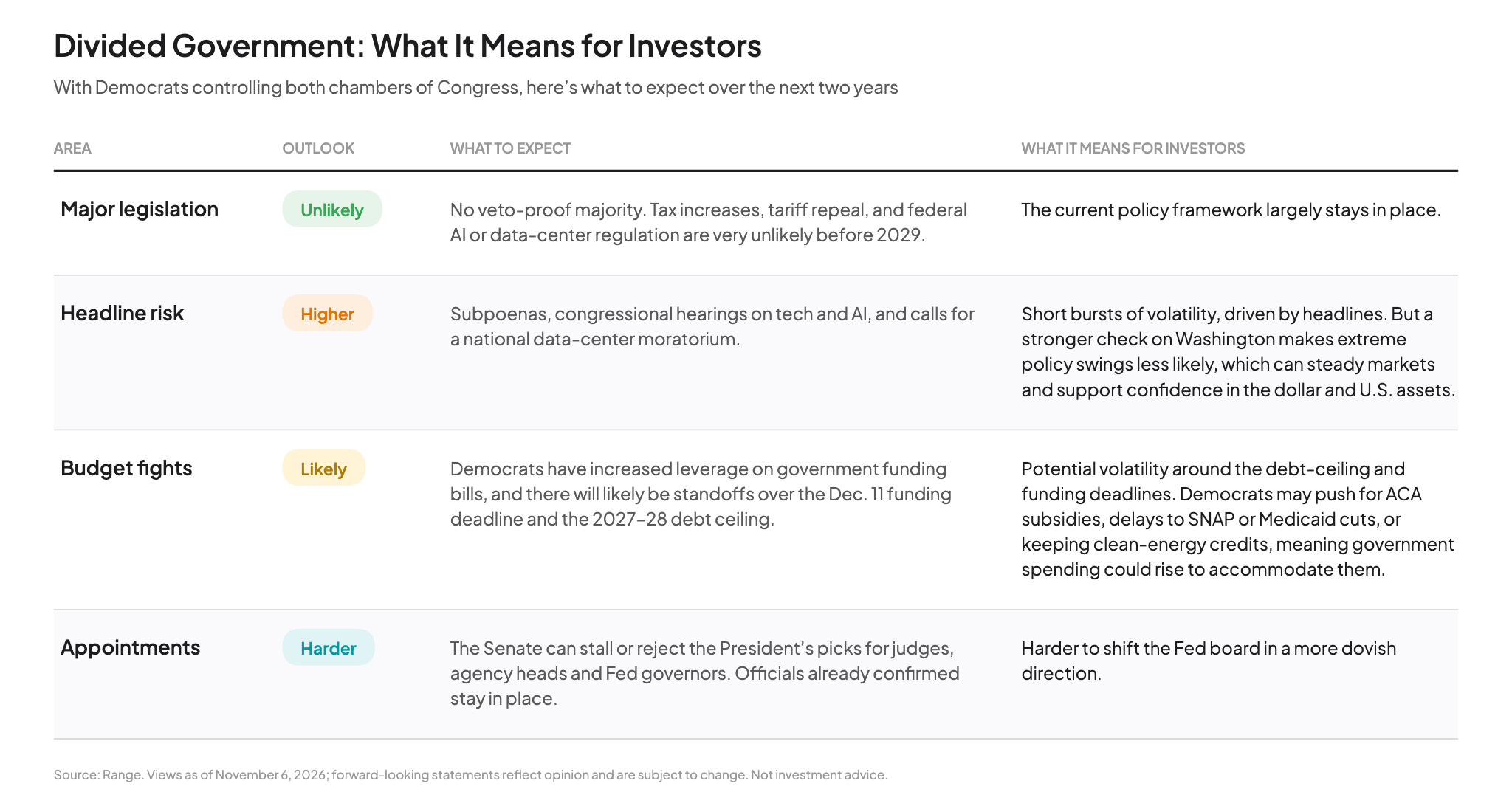
Divided Government: What It Means for Investors
With Democrats now controlling both chambers, Washington is headed for two years of divided government. For investors, the effects fall into four areas:
Gridlock and Markets
Gridlock tends to limit policy surprises, and markets are likely to read a Senate check on Fed appointments as support for the Fed’s independence. Both can support confidence in the dollar and dollar-denominated assets. Bond yields have also typically fallen after split-government results, since large new spending programs become harder to pass; the 10-year Treasury yield has averaged an 18 basis point decline in the month afterward. The main things to watch are the funding and debt-ceiling deadlines, which can bring short bursts of volatility.
That’s the federal picture. For AI, though, the results that matter most may have come from the states.
What’s Really Driving Markets: The States
Governors and state utility regulators control much of what it takes to build a data center: how it connects to the grid, what it pays for power, whether it gets tax breaks and how much water it can use. Tuesday’s results changed who holds those levers in several of the country’s biggest data-center markets, and that, more than anything in Congress, is what AI investors were reacting to on Thursday.
A Shift in State Power
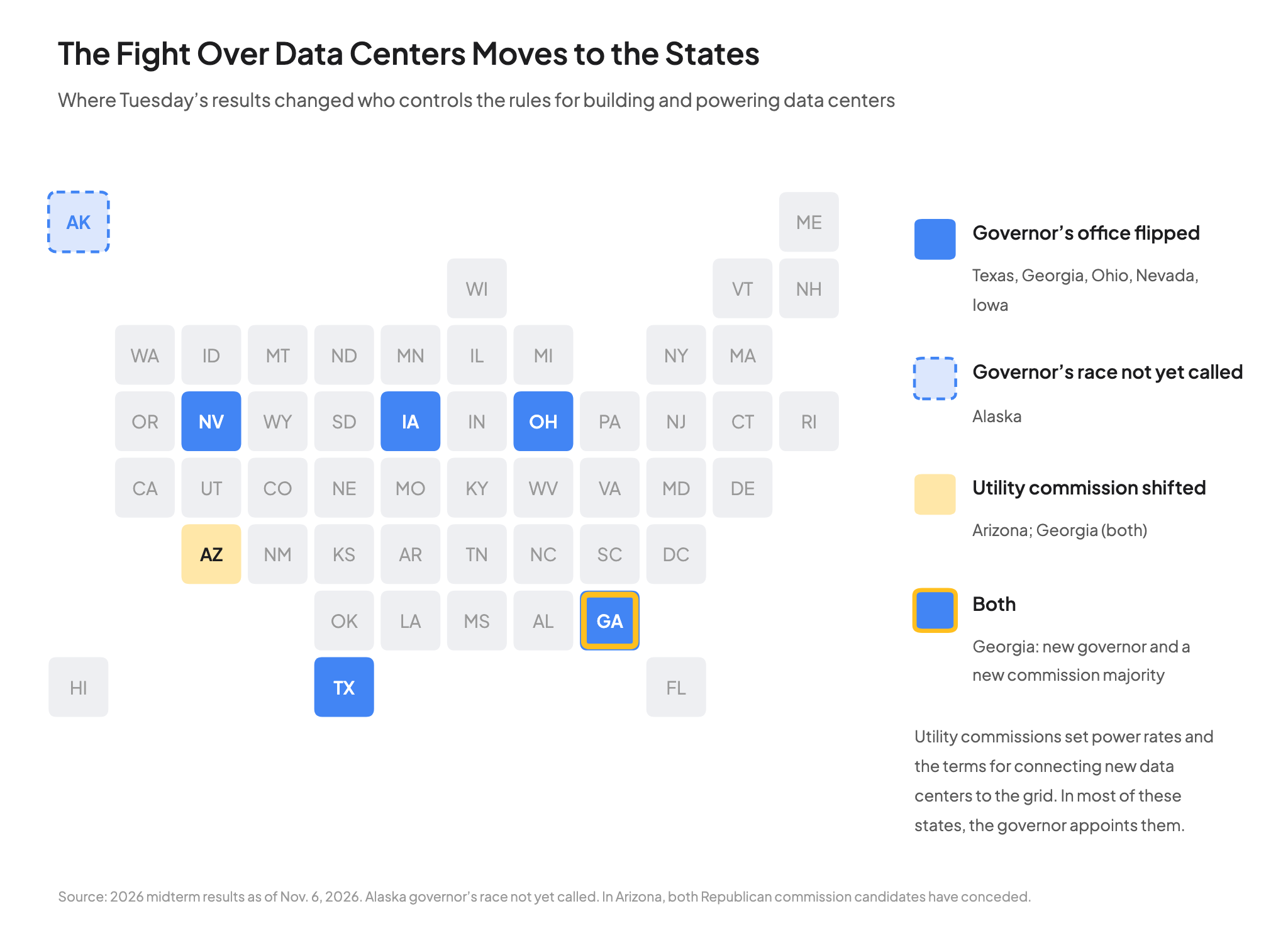
Six governorships flipped from Republican to Democrat: Texas, Georgia, Ohio, Nevada, Iowa and Alaska. Democrats also made their biggest gains on state utility commissions in decades. Those commissions are the regulators that set electricity rates and the terms for connecting new data centers to the grid.
In Georgia, Democrats won both seats on the ballot and will hold a 3–2 majority on the commission for the first time in decades. That puts a roughly 20 GW data-center pipeline under regulators who campaigned on lowering household power bills. In Arizona, Democrats are winning both open seats. That turns an all-Republican commission into a 3–2 split. In Texas, Ohio, Nevada, Iowa and Alaska, commissioners are appointed, so the new Democratic governors will reshape those boards over the next few years.
Texas Matters Most
Texas is the largest data-center growth market in the country. Analysts estimate it accounts for about 27% of planned U.S. data-center power. Governor-elect Gina Hinojosa, who takes office Jan. 19, has pledged a moratorium on new data-center permits, stricter water and power rules, and an end to tax breaks.
How much of that agenda becomes reality is another question. A broad statewide ban is unlikely because the legislature is split: Democrats flipped the Texas House, but Republicans held the Senate. The governor can still slow things down on her own. She can extend the freeze on new large data-center grid connections that Governor Abbott put in place in August, and she appoints the utility regulators who set the rules and costs for connecting new data centers to the grid.
The more likely outcome is higher costs, not a halt. Requiring data centers to pay their own grid costs, ending their tax breaks and tightening water rules all have a better chance of passing a divided legislature. Near-term capacity also looks largely safe. After Thursday’s close, Hinojosa said on CNN that “all currently permitted data centers in Texas will be allowed to finish construction.” The risk falls on new projects coming online in 2028 and beyond.
Where Markets Go From Here
Friday brought some relief. The Nasdaq bounced back 1.3%, and the biggest chip stocks had won back roughly a quarter of Thursday’s losses. The economy also gave investors good news: employers added 165,000 jobs in October, nearly three times what economists expected.
One good day doesn’t settle the trajectory of markets from here, but it’s a reminder that the outlook didn’t change as much as Thursday’s prices suggested.
The AI Trade: Potentially Slower, Not Derailed
Next year’s buildout is largely locked in. Most of the data centers set to open in 2027 already have their permits and power lined up, and the new proposed state rules mainly target projects that haven’t been approved yet. That means most of the AI spending planned for next year is already in motion.
Projects planned for 2028 and beyond face more risk, but past data-center pauses have tended to be shorter and softer than first proposed. Texas’s moratorium, for example, is designed to last only until new protections become law, and companies are already offering to pay their own power costs to get projects approved.
Demand still exceeds supply. The biggest risk for AI investors has always been overbuilding: spending hundreds of billions on data centers no one ends up needing. That’s what happened during the dot-com bust, when telecom companies laid so much fiber-optic cable that most of it sat unused for years, prices collapsed and many of the builders went bankrupt. This week’s election was about supply, not demand. Microsoft, Amazon and Google all say customers want more AI computing power than they can supply, and the leading maker of AI memory chips says its output is effectively sold out through 2029. Supply constraints may change the pace of earnings growth, but a shortage is a far better problem than a glut.
Our view: We don’t think the AI trade is broken. A buildout that may slow because of permits and politics is less worrying than one that’s slowing because customers don’t need it. Projects that get delayed tend to get built later rather than abandoned, and the capacity that already exists becomes more valuable.
That said, investors should expect more speed bumps. Financing costs were already acting as one over the past several months, and now regulation joins them.
Three Variables to Watch
Interest rates. For the AI buildout, borrowing costs may matter more than politics: a project can move to a friendlier state, but it can’t escape higher interest rates. The 10-year Treasury yield has fallen to a two-month low. From here, the direction depends mostly on inflation and the Fed.
Oil. Hopes for U.S.–Iran diplomacy have kept Brent crude just under $100. Lower oil helps keep inflation and interest rates in check and leaves consumers with more to spend. The risk is that talks stall and prices spike again.
The Anthropic IPO. Anthropic filed to go public in late October, in what could be a raise of about $100 billion. After this week’s turbulence in tech, some investors now question whether it will still list in November, and the valuation being discussed has come down. It will be the biggest test yet of investors’ appetite for AI. A strong debut would support the trade and show that investors are still willing to fund AI at scale, while a delay or steep discount could deepen worries about whether there’s enough capital to pay for the buildout.
History and Fundamentals Are on the Market’s Side
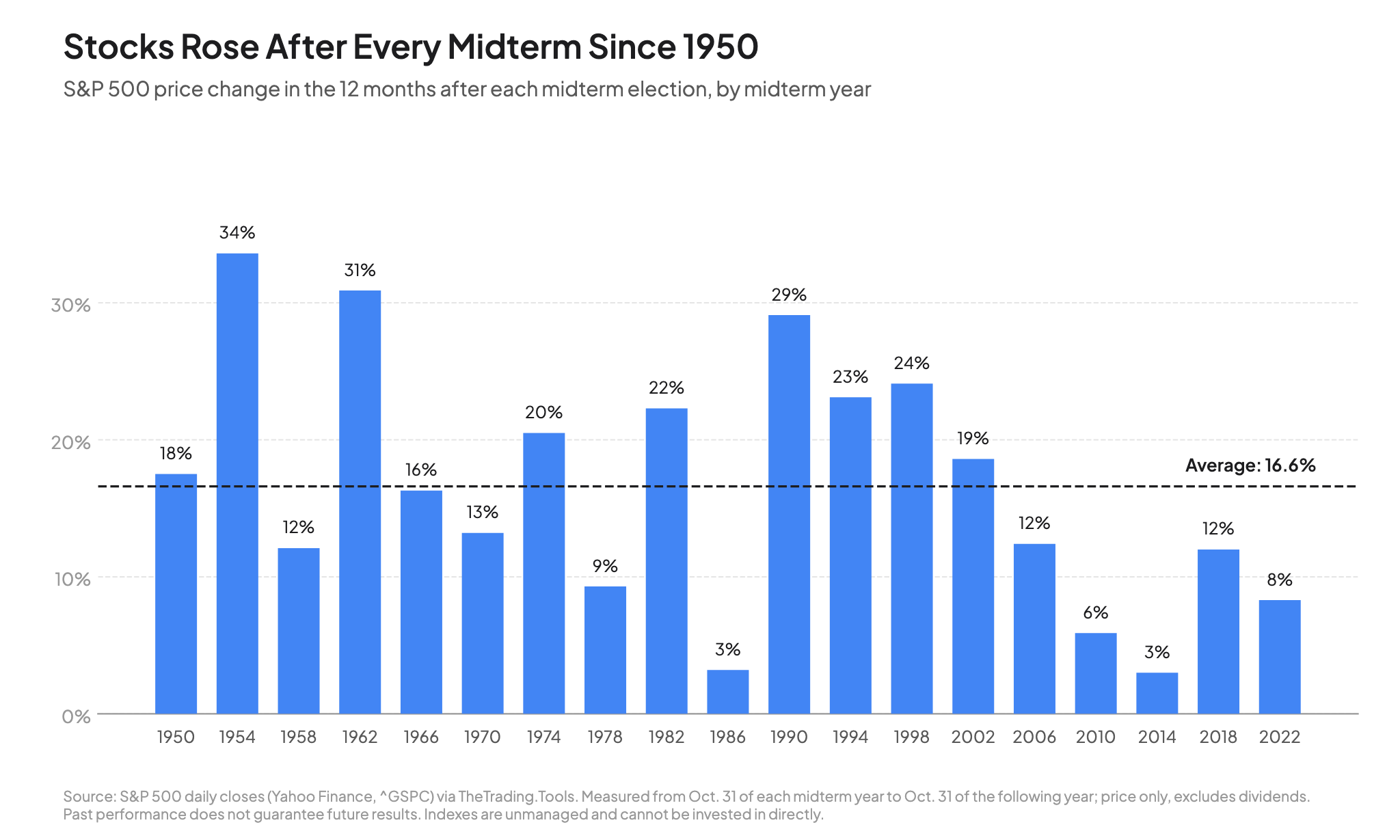
History offers some comfort.
The S&P 500 has been higher one year after every midterm since 1950, regardless of which party won, a pattern usually credited to uncertainty clearing rather than to the outcome itself. One caveat is that our current setup, a Republican president with a Democratic Congress, has historically delivered weaker returns than other combinations, though there are few examples to go on.
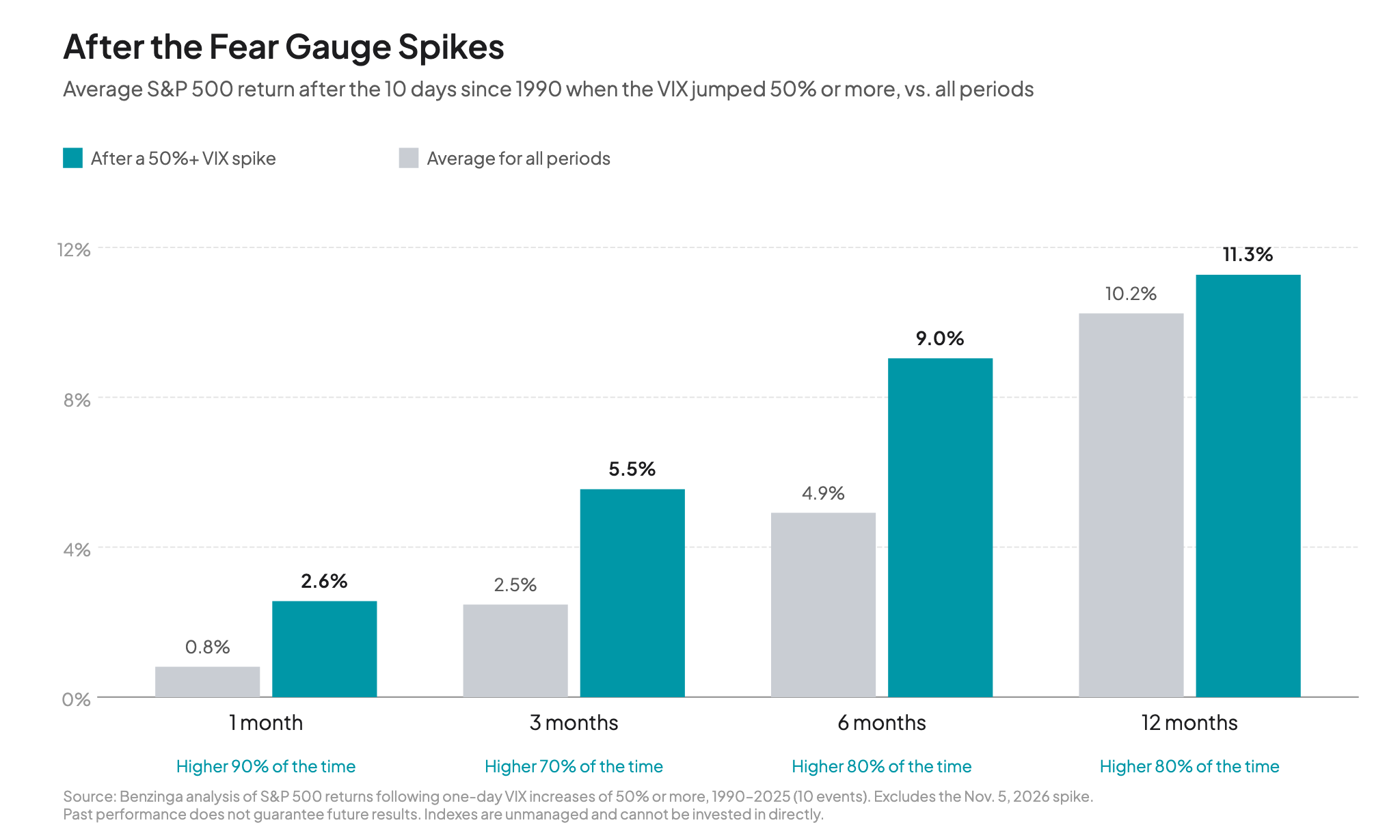
Thursday’s jump in the VIX was its third-biggest one-day rise since 1990. Spikes like this have rarely derailed long-term returns. Of the 10 previous days when the VIX jumped 50% or more, the S&P 500 was higher a year later in eight, with an average gain of about 11%, roughly what stocks return in a typical year. For long-term investors, sharp bouts of fear like this have usually been worth sitting through.
More importantly, the fundamental backdrop is still sturdy:
- The economy is strong. Unemployment fell to 4.1%, and worker productivity grew at a 3.6% annual rate last quarter, well above its long-term average of about 2%. In other words, workers are getting more done per hour without pushing up labor costs. That lets the economy grow without adding to inflation.
- Earnings keep delivering. More than 80% of S&P 500 companies reporting so far have beaten expectations, with earnings growing nearly 30% in Q3.
- Stocks are cheaper. The S&P 500’s valuation is now below 18x forward P/E, the cheapest since 2023. The Nasdaq’s multiple of 18.5x is the lowest it’s been since 2020. Valuations could keep falling from here, but both indexes now trade well below their 10-year averages of about 19x for the S&P 500 and about 23x for the Nasdaq, while earnings are still growing.
The Long View
The AI buildout has already worked through a series of bottlenecks: first chips, then memory, then power. Politics may be the hardest one yet, because you can’t solve it by building more. We don’t expect it to stop the buildout, but we do expect it to make the buildout slower, more expensive and more selective.
It’s hard to handicap how many campaign promises turn into policy, but a slowdown wouldn’t be bad news for everyone. Investors have been asking when all this spending will pay off. A more disciplined buildout could mean better returns on what does get built, and less risk of the kind of overbuilding we saw in the dot-com bust. For long-term, diversified investors, that may be the healthier path.
Disclosures:
This communication contains forward-looking statements that reflect Range Advisory, LLC’s (“Range”) current views, expectations, beliefs and/or projections about future events or results. Forward-looking statements involve risks and uncertainties — including, without limitation, market conditions, regulatory changes, economic conditions — any of which could cause actual results to differ materially from those expressed or implied by such statements. Range undertakes no obligation to update or revise any forward-looking statements to reflect new information, future events or otherwise, except as required by law. Recipients should not place undue reliance on forward-looking statements, which are presented for informational purposes only and do not constitute investment advice or a recommendation to buy, hold, or sell any security. Past performance is not indicative of future results. The views, opinions and analyses expressed by Range in this material are those of Range as of the date shown, and are provided for informational purposes only.