


With Q3 in the books and earnings season just getting underway, we sat down with our Chief Investment Officer, Taresh Batra, to talk about what’s driving markets this year, why rates are climbing, where we are in the AI cycle, and what he’s watching as we head into year-end.
Q: The S&P 500 is up 14% this year. How do you feel about the year markets are having so far?
Despite significant macro volatility, surging energy prices, and rising rates, the market is having a solid year. Early in Q4, the S&P 500 is right near its all-time high.
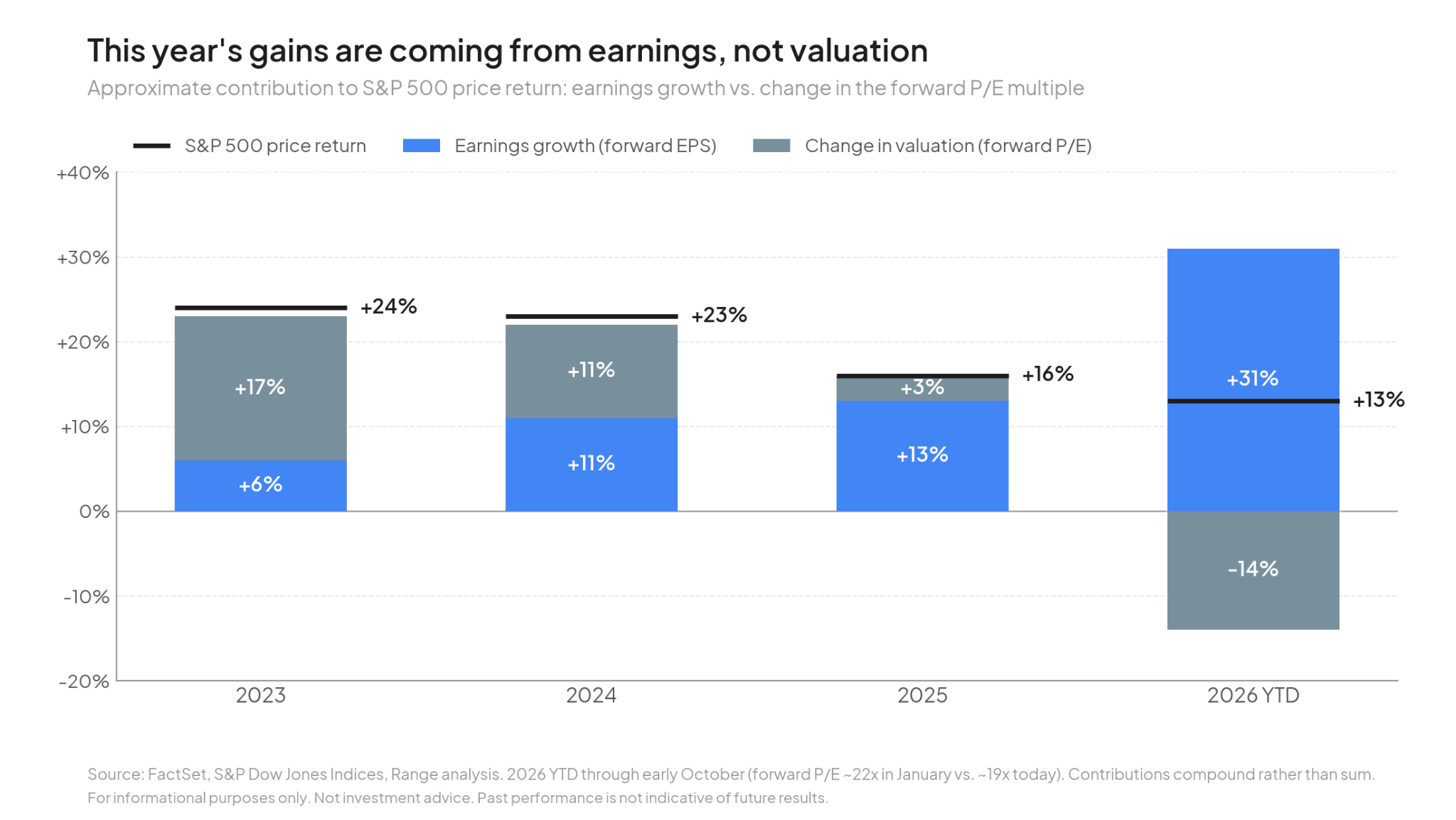
This has been entirely driven by earnings. Forward earnings estimates are up 31% since the beginning of the year, more than two times the market’s gain. So the index has actually gotten cheaper, now trading at around a 19x P/E multiple vs. 22x in January.
In 2023 and 2024, most of the market's gains came from a rising multiple rather than from earnings growth. This year, it’s the opposite.
Q: Why are valuations coming down? And what does that mean for investors?
A saying we use often here is “respect the market.” Between the end of 2022 and 2025, the S&P 500’s valuation rose from under 17x to 23x as investors anticipated that rates would come down and earnings would accelerate. They were right.
In 2026, valuations have started moving the other way. In our view, that suggests that while earnings are growing at an extraordinary rate, investors (reasonably) expect that pace to slow.
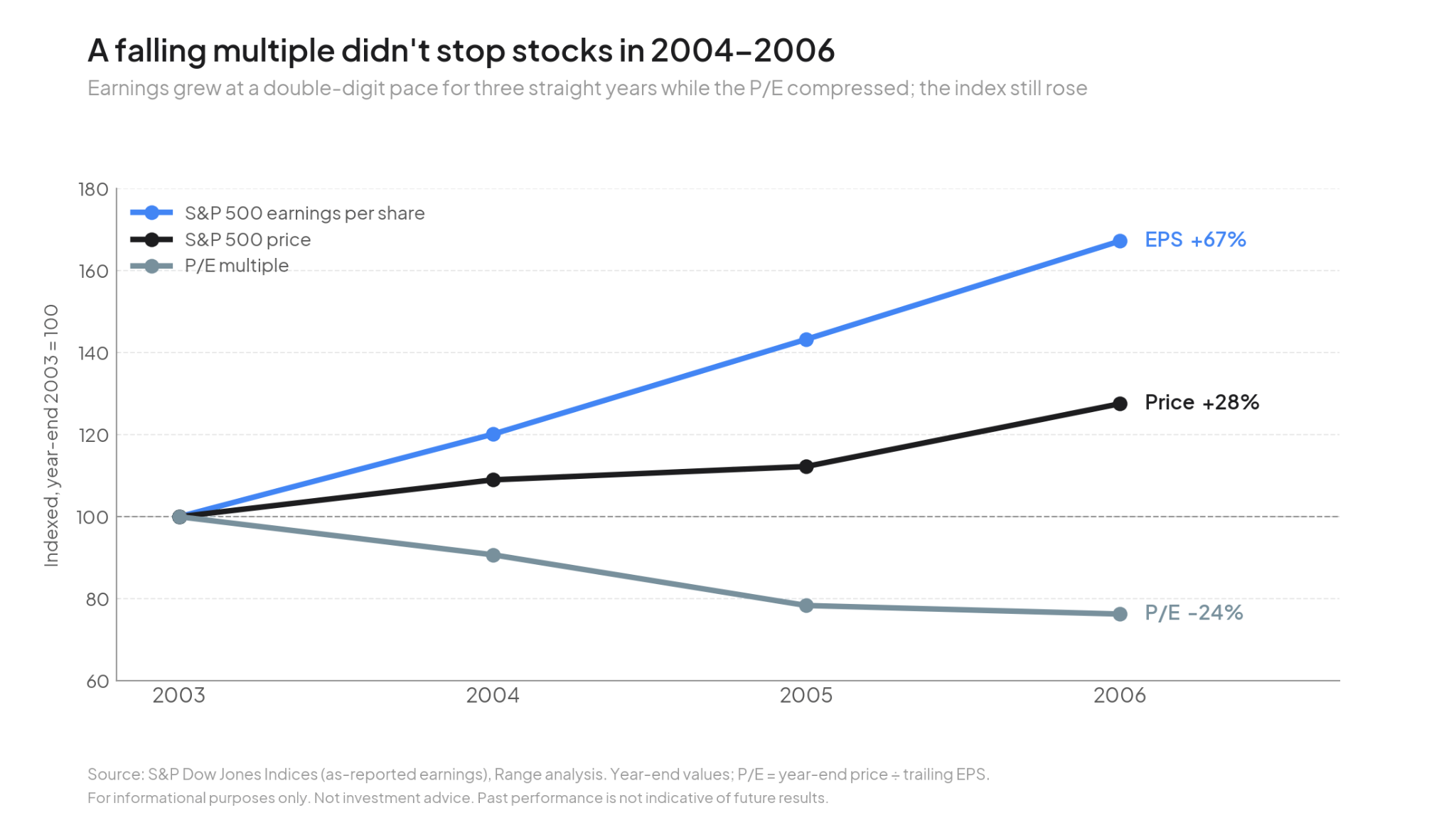
A lower valuation doesn’t necessarily mean stocks have to fall. From 2004 through 2006, S&P 500 earnings grew at a double-digit pace for three straight years while valuations fell. Stocks still rose in that period because earnings growth more than offset the lower price investors were willing to pay. We believe a similar pattern is possible today. The difference is that with valuations already adjusting, we think there may be less room for earnings to disappoint.
Q: Rates are getting all the headlines. Are you concerned about rising rates?
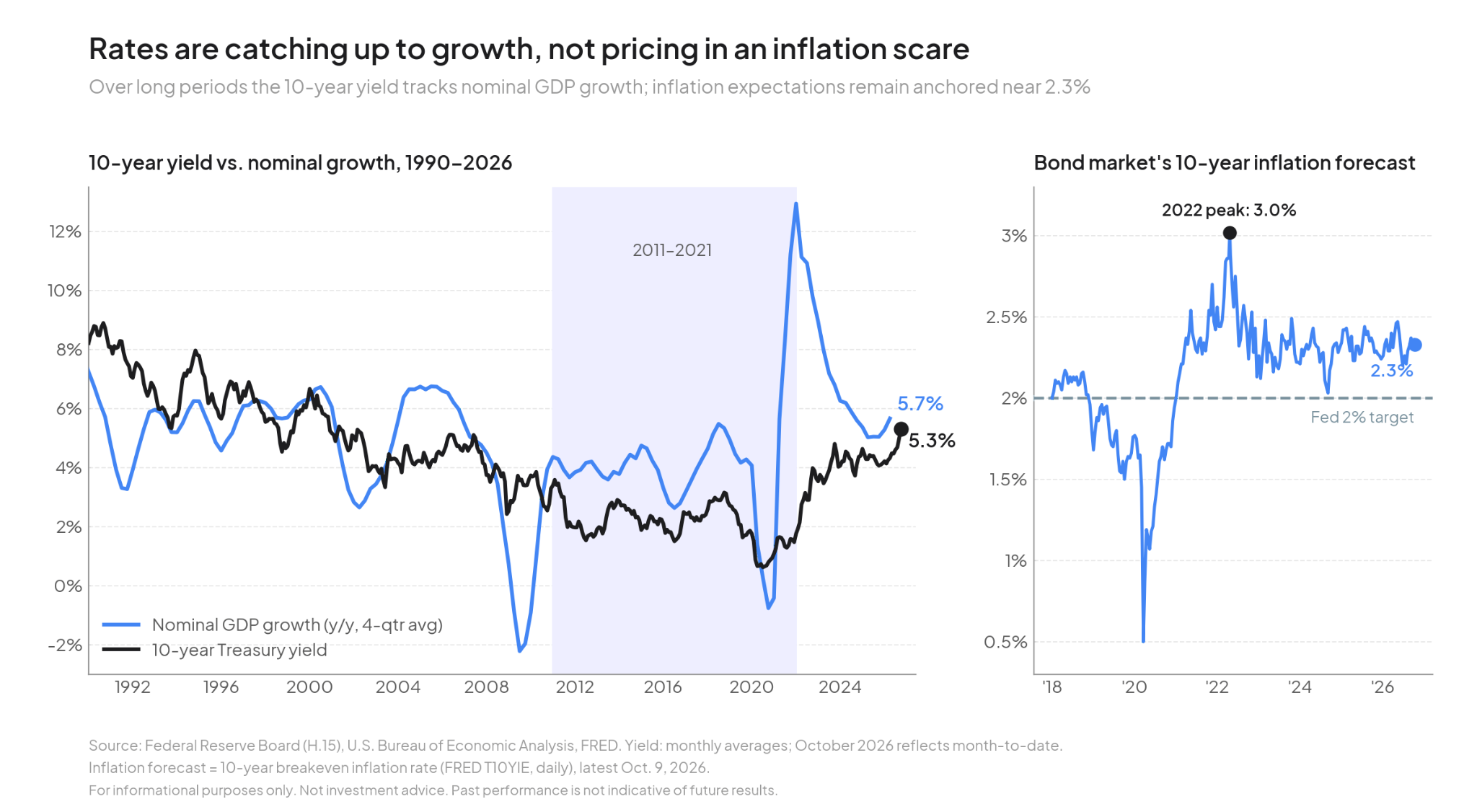
Somewhat, but less than the headlines might suggest. The 10-year Treasury yield has climbed from 4.2% to 5.3% this year, its highest level since 2002, and higher rates can weigh on stocks. But in our view, why rates are rising matters as much as how high they go.
If the move were driven purely by inflation, that could be a tougher backdrop for stocks. In 2022, inflation peaked above 9% and expectations for future inflation rose to their highest level in two decades. The Fed responded with more than 500 basis points of hikes in about 16 months, and markets struggled to absorb it.
Today looks different. Inflation isn’t at the Fed’s 2% target, but it has held in a fairly stable range of roughly 2.7–3.1% for the past 18 months. Inflation expectations have also stayed anchored: the bond market’s 10-year inflation forecast is about 2.4%, right where it started the year.
That leads us to believe the more likely driver of higher rates is an economy growing faster than expected. In January, forecasters expected nominal growth of about 5% this year. Instead, the economy is growing more than 6%. Over long periods, the 10-year yield has tended to track nominal growth, since a Treasury bond is ultimately a claim on the economy’s income. By that measure, we don’t view a 10-year at 5.3% with the economy growing 6% as a sign of a bond market in distress. We believe it’s more likely rates catching up to growth.
Q: So you’re not worried that higher rates will derail the economy?
It depends on which economy we’re talking about. Nearly 50 cents of every dollar invested in the S&P 500 goes to technology and communications stocks, many of which are benefiting from an unprecedented secular AI boom that, in our view, is outweighing cyclical pressure. The largest of these companies are cash-rich and can fund much of their expansion themselves, so we believe higher borrowing costs are less likely to force them to pull back.
The broader economy is more exposed. So far this year, consumer spending has been strong, and manufacturing has picked up in industries beyond technology. But higher rates take time to bite. More expensive mortgages can slow home sales and the spending that comes with them. Property owners and small businesses refinancing debt may have less left over to invest or hire. Consumers carrying credit-card balances could have less to spend as interest costs rise.
We believe there’s still meaningful cushion in the economy, but the longer rates stay elevated, the thinner that buffer could get, and the more the market may come to depend on the AI trade.
Q: Which brings us to AI. Where are we in the cycle?
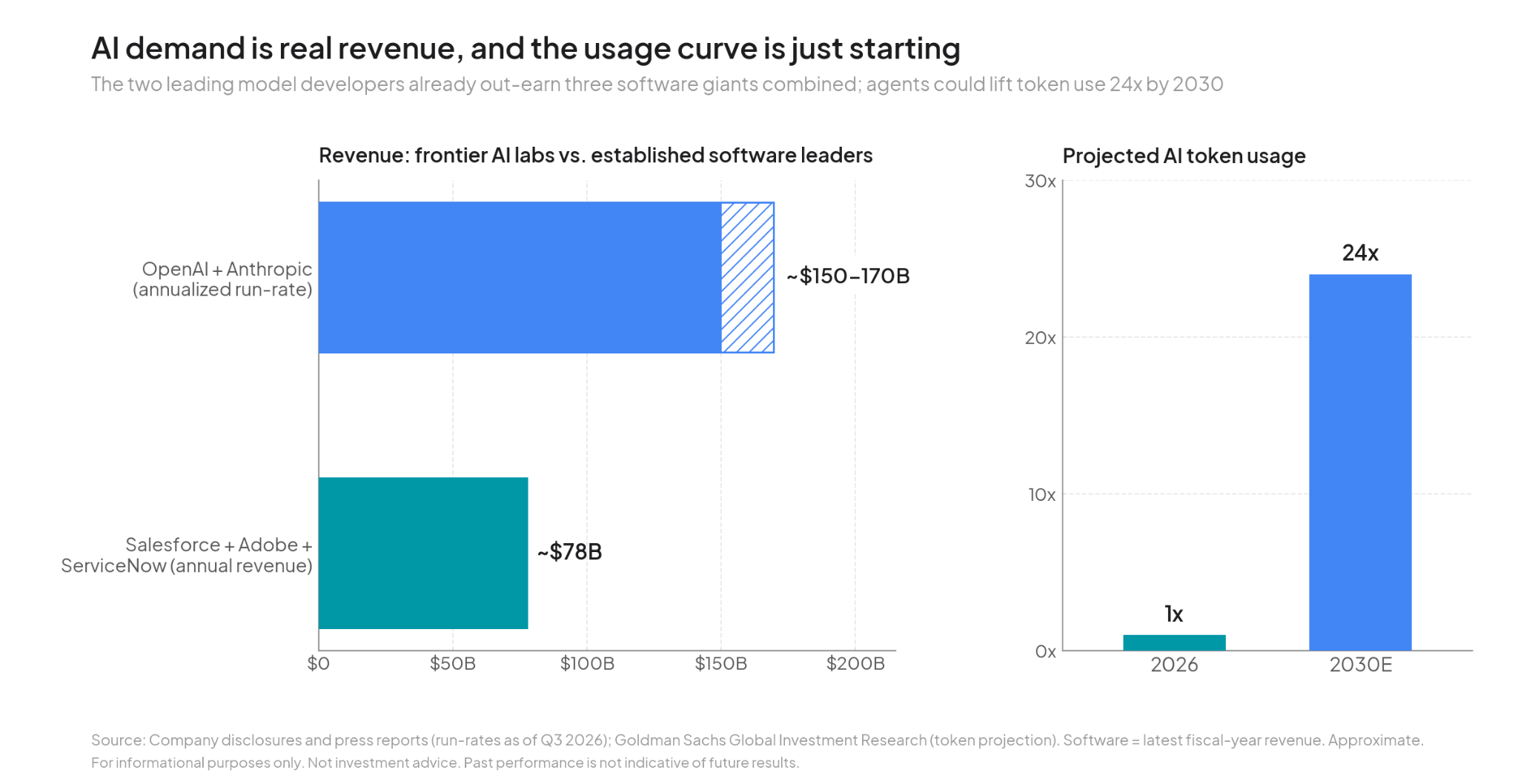
We continue to believe we’re in the early innings of AI adoption. OpenAI and Anthropic are already generating revenue at a combined annualized pace approaching $170 billion, more than twice the annual revenue of Salesforce, Adobe and ServiceNow combined. And AI is only beginning to move from answering questions to completing tasks: software engineers were the first to adopt agents, but with the explosive growth of virtual assistants like Muse and Instinct, the agentic shift is starting to reach everyday consumers.
We believe that bodes well for continued AI investment. Goldman Sachs estimates that, as agents spread, total AI token use could rise 24-fold between 2026 and 2030.
OpenAI’s data offers a glimpse of what deeper adoption looks like today: its most active 10% of enterprise customers use more than 8 times as many tokens per user as a typical customer.
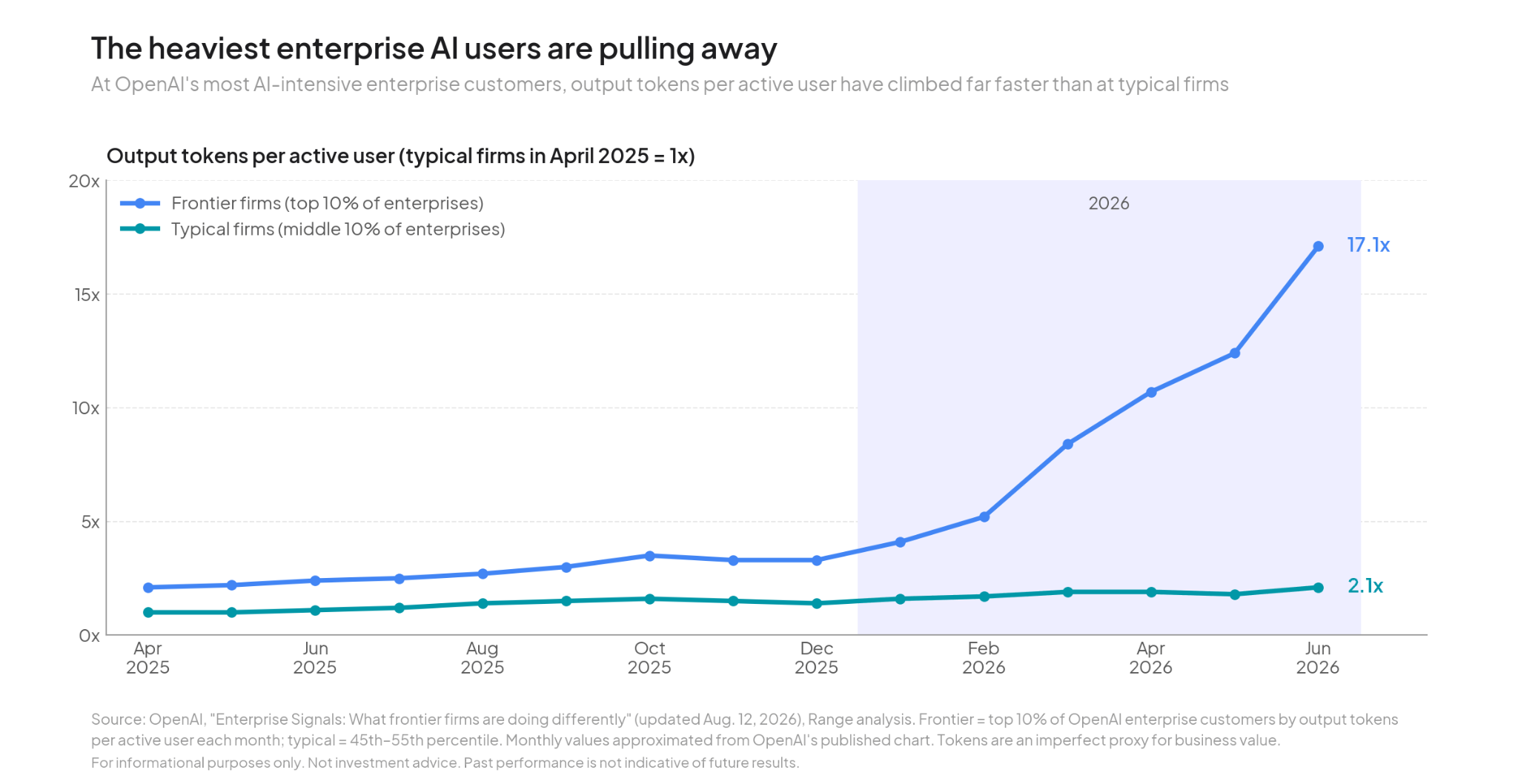
As AI usage keeps shifting from “tell me” to “do it for me,” we expect that token growth to support continued investment in chips, memory, and data centers. Recent commentary from the AI supply chain is consistent with this view. Last week, Micron’s CEO said:
“We do not have line of sight to when supply and demand will return to balance. In calendar 2027 as well as 2028, we see demand exceeding supply. In fact, we see greater tightness in the industry in 2027 and in 2028 versus 2026.”
Q: If the demand story is that strong, what’s the risk?
The long-term demand picture is only half the investment story. Stock prices reflect what investors already expect. For them to keep rising, companies generally need to deliver more than the market has priced in and give analysts reason to raise their forecasts again.
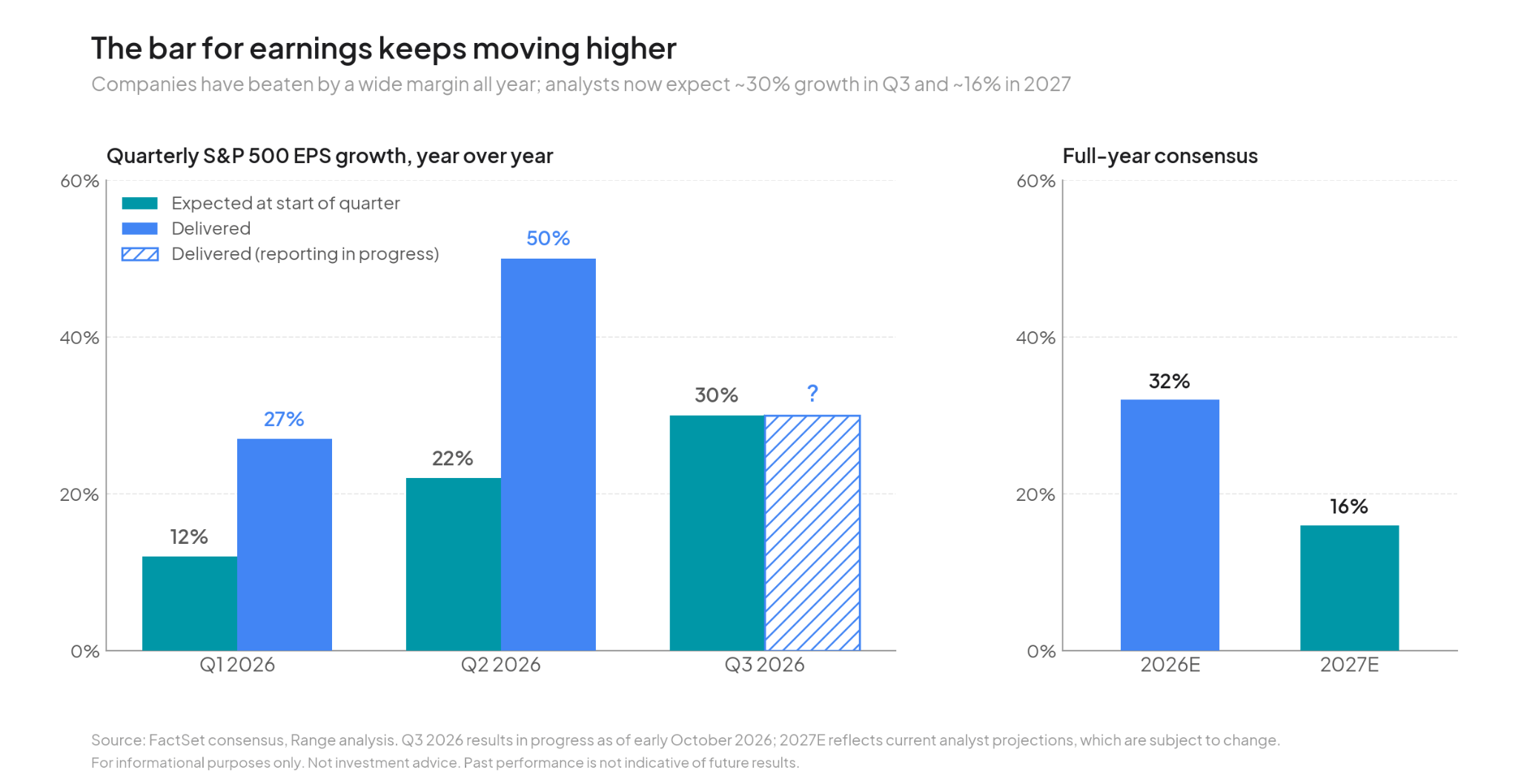
That bar keeps moving higher. In Q1, analysts expected roughly 12% earnings growth for the S&P 500, and companies delivered about 27%. In Q2, analysts expected 22%, and companies delivered 50%.
For Q3, analysts are expecting nearly 30% growth. Results are just starting to come in, but early beats look much smaller than in prior quarters. We’ll be watching whether that pattern holds as more companies report and, even more closely, what they say about 2027.
Q: What are you watching as we enter Q4?
We’re in an environment of strong growth, higher rates and, we believe, lower valuations for stocks. That doesn’t mean stocks can’t keep rising. In our view, earnings could still support the market even if growth slows from this year’s exceptional pace. The question is whether it slows more than investors expect.
That makes two variables especially important this quarter: rates and earnings.
Rates
We’re not overly concerned about where rates are today. We’d become more concerned if they kept rising quickly, particularly if the Fed’s October meeting left bond investors questioning its willingness to address inflation. In that case, investors could demand higher yields because they’re worried about future inflation rather than because the economy is growing faster. We believe that would put more pressure on both valuations and the broader economy.
There’s a more encouraging path, too: if energy prices ease, rates could stabilize or come down.
Either way, we don’t expect a return to the ultra-low rates investors got used to between 2011 and 2021. In our view, this new rate regime comes with costs, but also potential opportunities:
- Cash can work harder. With short-term rates around 4%, cash held in a low-yield bank account may be giving up meaningful income. We don’t believe it’s necessary to sell equities to hold cash that isn’t needed, but money market funds and Treasury bills currently offer higher yields while maintaining near-term liquidity.
- Bonds might deserve another look. Higher yields have changed the case for bonds. Seven-year Treasuries averaged about 2% during the 2010s; today they yield just over 5%. Rates could still rise and push bond prices down, but higher starting yields provide more income that could help offset part of that decline. And if the economy slows and rates fall, bonds could gain value at a time when stocks may be under pressure.
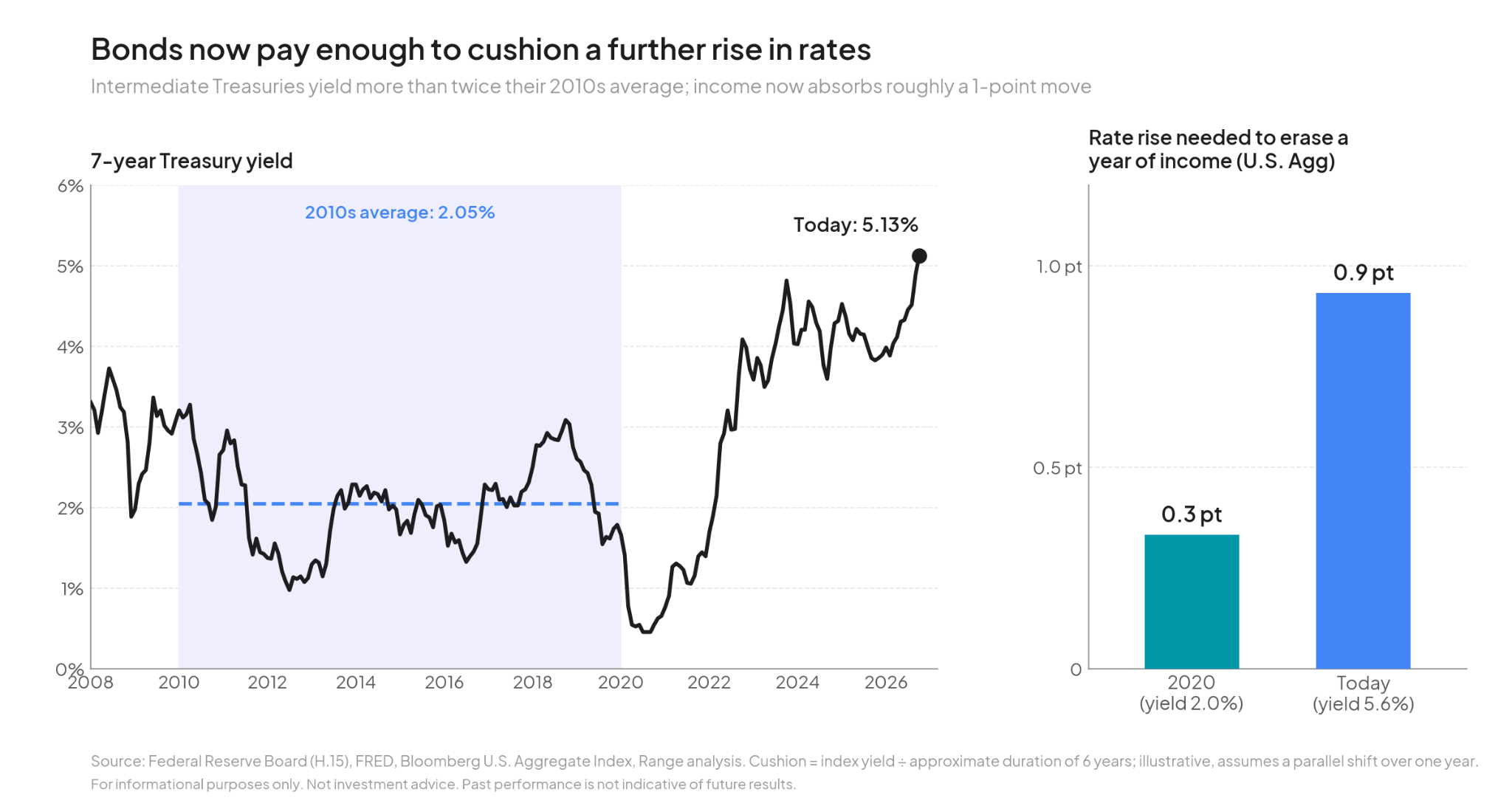
We’re not saying bonds will beat stocks. But we believe the entry point has improved, and the gap in potential returns between the two has narrowed.
Earnings
Attention is shifting from the macro to the micro as Q3 reporting season picks up. We expect the results themselves to be solid: analysts project nearly 30% growth, and companies have beaten by a wide margin all year. What we think matters more is the size of those beats and what companies say about next year.
Some slowing is expected. Analysts project about 16% earnings growth in 2027, following roughly 32% this year. That would still be a strong year for profits by historical standards. But we don’t expect valuations to rise from here, and they could fall further, so we believe earnings would need to keep doing the heavy lifting. The risk is that they run out of steam: either growth slows faster than expected, or good results stop giving analysts reason to raise next year’s forecasts.
In our view, this environment favors discipline over reaching for returns:
- Quality may matter more. When earnings are doing the work, we believe companies with strong balance sheets, consistent profitability, and the ability to fund their own growth are better positioned. Higher rates have historically been hardest on companies that rely on borrowing or on the promise of future profits, since they may have less cushion if growth slows or financing tightens. We don’t believe this is an environment that rewards reaching for the most speculative corners of the AI trade or adding leverage.
- Concentration risk can cut both ways. Market leadership has changed hands repeatedly this year. Mid-caps and international stocks have had their moments, the Magnificent Seven have gone from laggards to leaders, and crowded momentum trades have suffered sharp reversals. Even being right about the long-term winners hasn’t guaranteed a smooth ride: hedge fund Coatue recently showed that a strategy betting on AI winners and against AI losers suffered a 46% drawdown in just 49 days this summer. When too much of a portfolio depends on one trade, even a temporary reversal can do significant damage. Diversification can help investors participate in market gains without relying on any single trade. After several years of concentrated leadership, your portfolio may have drifted toward more concentration than intended.
Q: How are you thinking about the rest of the year?
The story of 2026 so far is a market that got cheaper as it went up. Earnings did the work while valuations came down.
With rates and near-term expectations both higher than they’ve been in years, the market is leaning on fewer supports. We don’t view that as a reason to step back from the market, but we do think it calls for discipline: reassessing the role of bonds, favoring quality, and avoiding overreliance on any single trade.
Disclosures:
This communication contains forward-looking statements that reflect Range Advisory, LLC’s (“Range”) current views, expectations, beliefs and/or projections about future events or results. Forward-looking statements involve risks and uncertainties — including, without limitation, market conditions, regulatory changes, economic conditions — any of which could cause actual results to differ materially from those expressed or implied by such statements. Range undertakes no obligation to update or revise any forward-looking statements to reflect new information, future events or otherwise, except as required by law. Recipients should not place undue reliance on forward-looking statements, which are presented for informational purposes only and do not constitute investment advice or a recommendation to buy, hold, or sell any security. Past performance is not indicative of future results. The views, opinions and analyses expressed by Range in this material are those of Range as of the date shown, and are provided for informational purposes only.




.svg)
.svg)
.svg)

