


Think of a service business: a restaurant, a hotel, a gym. Each offers a set service for a set price. Those prices aren’t static. They may drift a little above or below inflation each year, but broadly, you can expect a similar service for a similar price over time.
If any of these businesses want to raise prices above and beyond inflation, they typically need to raise their quality. For a restaurant, better ingredients. A hotel, an ocean view room. A gym, perhaps, cutting-edge equipment.
Now imagine if before entering any of these businesses you had to disclose your net worth at the door. And that, rather than the quality of the service, determined your price.
Say you had a good year, and that meant a restaurant would charge you more for the same steak as they would another diner, or imagine if a hotel priced your room off your brokerage statement. Same building, same staff, same experience, but your bill is determined on the basis that “they do better as you do better.”
You would probably leave. Not necessarily because the experience was bad, but because the pricing has nothing to do with what you’re actually buying.
Yet this is exactly how most people pay for financial advice. And they stick around for decades.
What you’re actually paying
The standard arrangement can look like this: advisors often charge about 1% of your assets each year, and the funds they purchase on your behalf can charge about 0.4% in expense ratios. All in, you could be looking at a fee of ~1.4% of your total investable assets.
The rate doesn’t change each year. Which, on the surface, feels fair. Same service, same price, right? Not exactly. The rate doesn’t change, but the bill does—every single year, and, if your investments are seeing even average returns, at a rate much higher than inflation.
Advisors link their fees to your investment returns. While inflation rises 2-3% each year, the market, on average, rises 7-9%. That’s about 3x inflation. This is a great business model for advisors, and a poor one for you.
Here is what that inflation chart looks like next to pricing changes in the service businesses that do have to justify their price increases, and in the one exception that doesn’t (your 1% AUM fee advisor):
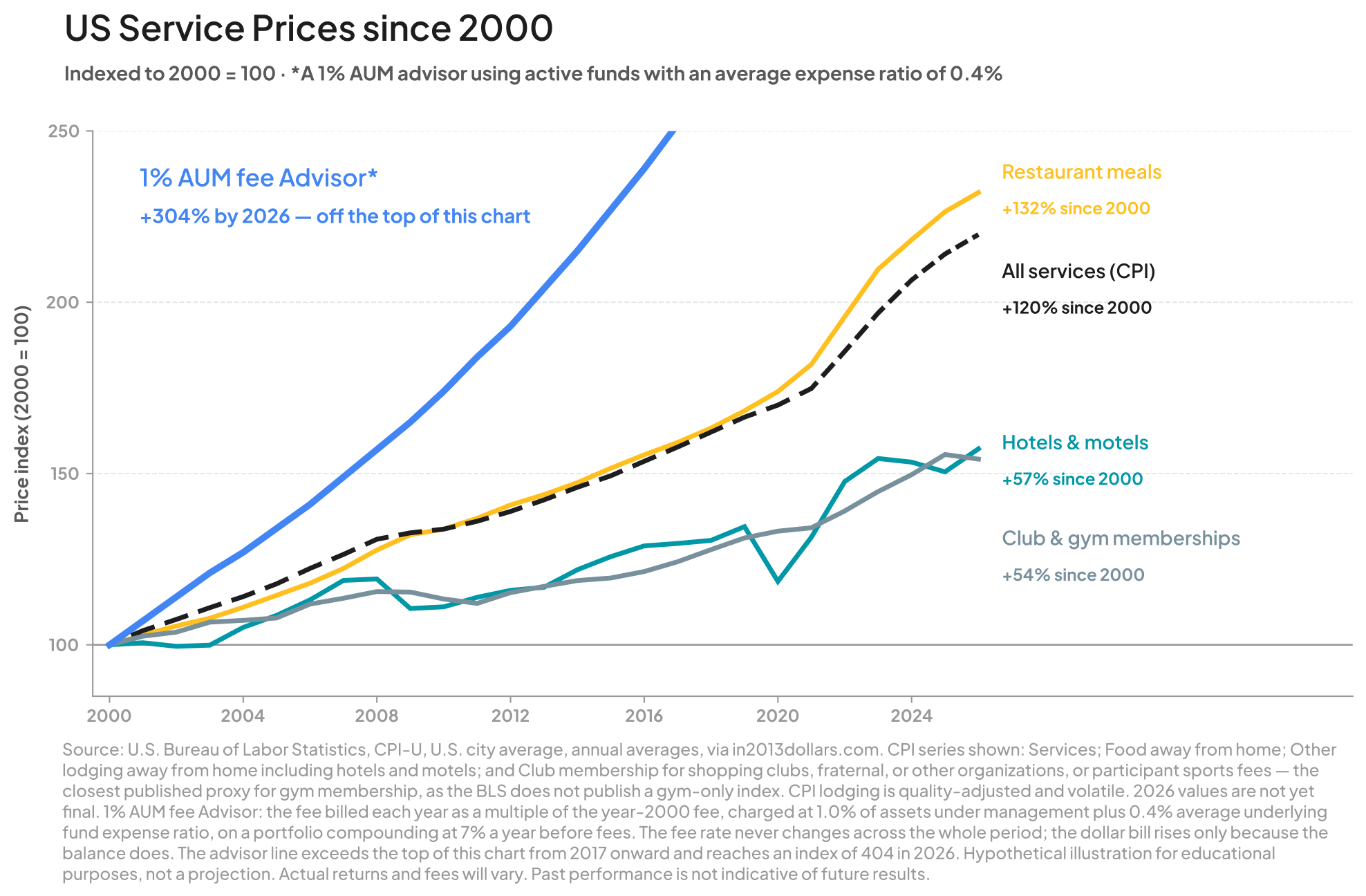
The S&P 500 returned 26.3% in 2023,1 25.0% in 2024,2 and 17.9% in 2025.3 Your advisor’s bill rose right along with it.
Add in the S&P 500’s return so far in 2026, and the market is up 100% since the start of 2023.
Has your advisor’s workload doubled in less than 4 years?
What should bother you most is that, for the most part, you’re not paying for the work your advisor is doing. You are paying for work the market is doing. Your advisor and their fee are simply taking the credit.
How to lose a third of your potential wealth
You may still think of a 1% fee as a rounding error. A 1% sale at a store would never move the needle on a purchase, so why should you care about it as a fee?
Suppose the market returns ~7% each year, and inflation eats 2-3% of it, leaving you with a 4-5% real return. If your advisor and fund fees take 1.4%, that “rounding error” fee shaves about 30% of your return, every year, for as long as you’re with your advisor.
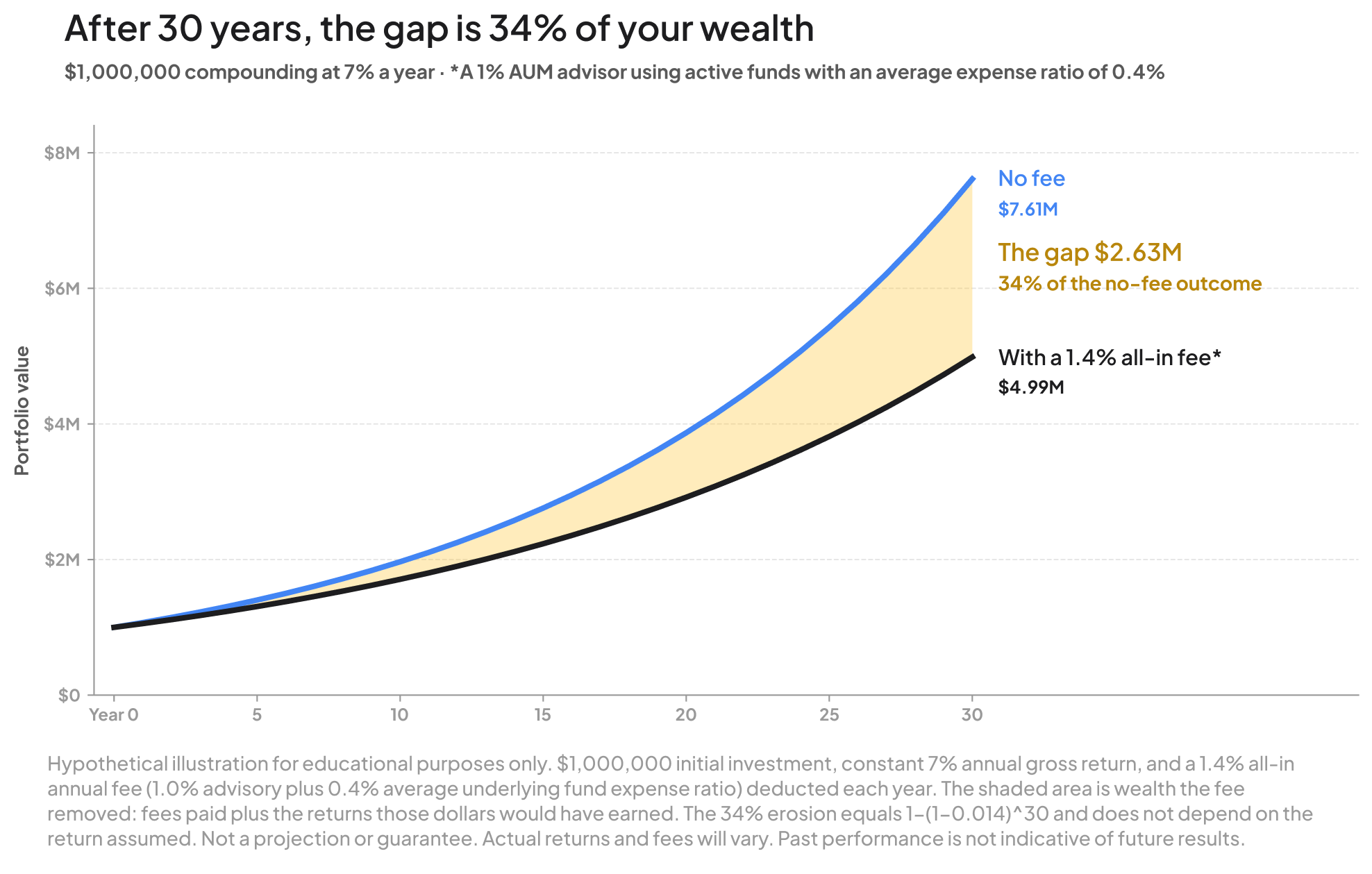
Over 30 years, you would pay nearly $1.1 million in fees and miss out on more than $1.5 million in potential compounding, on a $1 million portfolio. Your advisor would create more than $2.6 million in potential wealth for themselves and fund companies (assuming they reinvest fees) on your original $1 million investment, despite only “creating” ~$4 million in additional wealth for yourself.
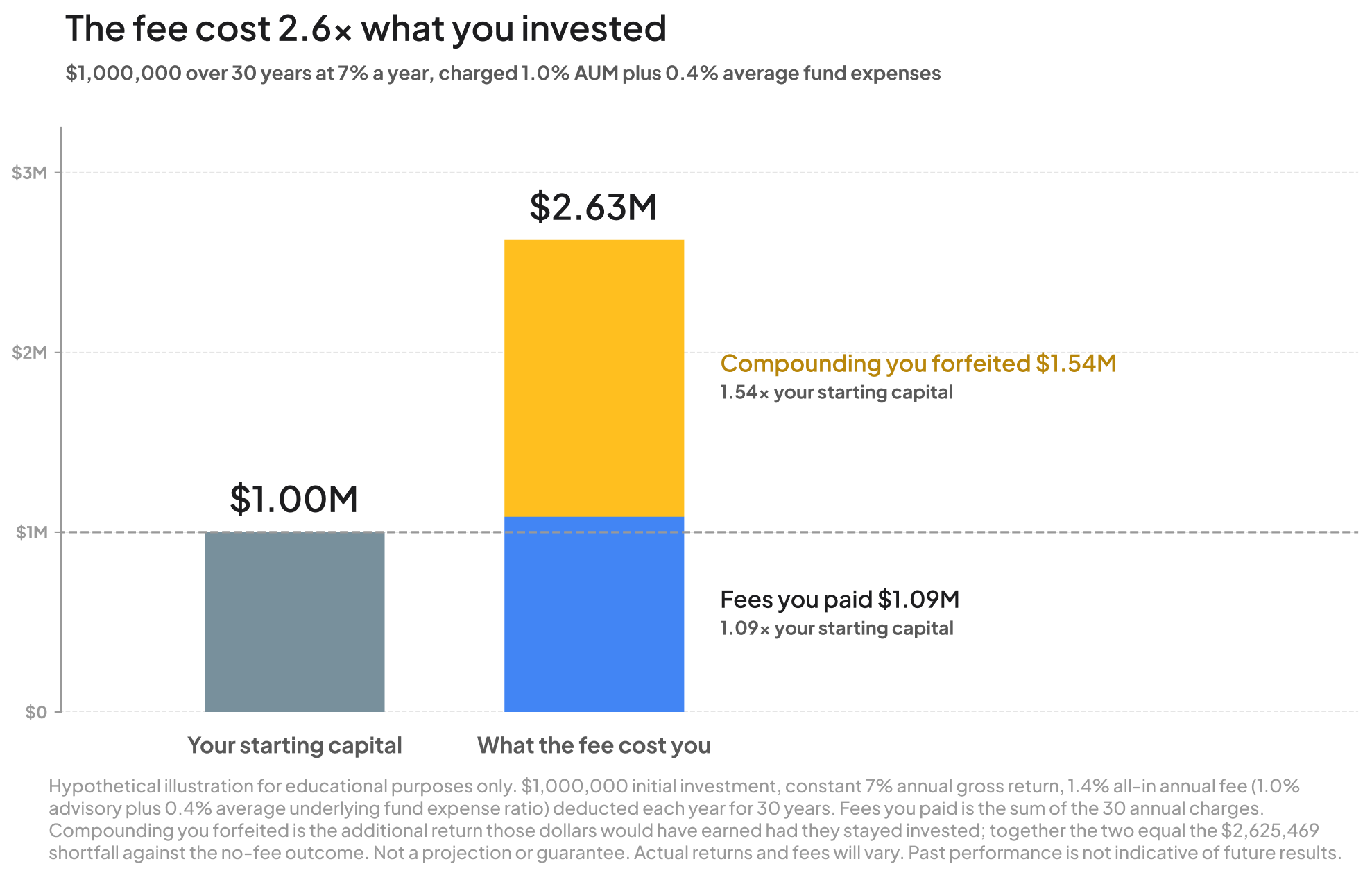
Through the magic of compounding, fees and lost compounding evaporate millions of dollars and more than a third of your potential wealth, enriching someone who leveraged the power of markets and math on your dollars, rather than their own.
The counterargument
Now to say an advisor’s fee shouldn’t ever rise with wealth would be disingenuous. As your assets grow, it’s possible complexity does as well. A family with $5 million generally may have more accounts, embedded gains, and complex estate and tax needs than one with $1 million.
But are they 5x more complex? Probably not.
For most people, the jump from $1 million to $5 million comes from compounding your investments, not your complexity.
Good financial advice is valuable, but most of it doesn’t scale with your portfolio. A tax-aware investment portfolio, solid estate and insurance planning, and the peace of mind to hold through market dislocations are all important. They are also (for the most part) rarely informed by how wealthy you are.
A flat fee4, or one that at the very least scales with complexity rather than the market, feels much more logical.
A final test
Maybe your advisor really is great. Maybe, in your mind, they’re even worth a 1% fee and millions of dollars of your wealth. Let’s put that to the test.
Advisors generally deduct fees from your account every quarter, without any active participation on your part.
Now imagine you had to physically write a check every quarter. Would you do it?
If you had $5 million, would you be comfortable writing your advisor a check for more than $12,000 every 3 months?5 What if this check grew with your portfolio for the rest of your life, to $25,000 per quarter in 15 years, and almost $60,000 in 30 years? Roughly a quarter million dollars per year for an annual meeting, a local golf outing, and a two-drink ticket dinner at the Capital Grille.
Are those dollars better off in their hands, or the hands of you and your heirs? They could be put to work in your children’s college fund, directed toward the trip of a lifetime you keep putting off, or perhaps gifted to the charity you hope to leave your nest egg to when you pass away.
Only you can answer that. But at least now you know the real size of the question.
If that fee stings, consider a flat-fee model instead. Range charges 0% AUM fees.4 Our members pay one transparent, all-in membership fee for comprehensive wealth management—investment management, tax strategy, estate planning, financial planning—with no hidden surprises.
What is your advisor actually costing you? Calculate the real cost of your AUM fee here.6
Disclosures
1 S&P 500 total return (with dividends reinvested) was 26.29% for the calendar year ended December 31, 2023. Source: S&P Dow Jones Indices.
2 S&P 500 total return (with dividends reinvested) was 25.02% for the calendar year ended December 31, 2024. Source: S&P Dow Jones Indices.
3 S&P 500 total return (with dividends reinvested) was 17.88% for the calendar year ended December 31, 2025. Source: S&P Dow Jones Indices.
4 Range Finance, Inc. charges a flat annual membership fee ranging from $3,950 to $12,500 depending on tier. Brokerage fees, transaction charges, and other applicable platform fees imposed by our custodian are not included in your membership and will be passed through to you as the Member. Additionally, fund fees charged by third-party managers (such as mutual fund or ETF expense ratios) will apply; these fees are separate from your membership and are not received or shared by Range in any way. Third-party fees typically range from 0–22 bps. See range.com/pricing.
5 Assuming 1% AUM fee.
6 Cost of AUM fee advisor figures are illustrative, not guaranteed, and are based on the following sources: NerdWallet, “How Much Does a Financial Advisor Cost in 2026?”; ICI Research Perspective, Trends in the Expenses and Fees of Funds, 2025, March 2026, Vol. 32, No. 1; Fidelity, “What Is an Expense Ratio?”
The information contained in this page is for informational purposes only. This content may not be relied on in any manner as legal, tax, regulatory, or investment advice. Range Advisory, LLC (“Range Advisory”) does not make any representation or warranty, express or implied, as to the accuracy or completeness of the information contained herein and nothing contained herein should be relied upon as a promise or representation as to past or future events. All figures and allocations shown are for illustrative purposes only and are not recommendations. All investments involve a high degree of risk, including the possible loss of some or all of an investment. Past performance does not guarantee future results.
Range Advisory, LLC and Range Tax, LLC are wholly owned subsidiaries of Range Finance, Inc (“Range”). Tax services are provided by Range Tax, LLC. Investment advisory services are provided by Range Advisory, LLC. Range Advisory, LLC is an SEC-registered investment adviser. Registration with the SEC does not imply any level of skill or training. Investment advisory services by Range Advisory, LLC. Custody and brokerage services provided by Altruist Financial, LLC and Apex Clearing Corporation, both independent SEC-registered broker-dealers. Range Advisory, LLC pricing and additional information can be found at range.com. Please refer to Range’s Form ADV Part 2A found on range.com for additional information about advisory services, fees, and risks.




.svg)
.svg)
.svg)

