


IRS Tax Extensions, Explained
A tax extension allows you to take up to an additional six months to file your tax return, extending your deadline to October 15 (or the next business day if the 15th falls on a weekend or holiday). The IRS does not require a reason to extend a return, and any taxpayer can do so. However, it's important to understand the difference between filing and paying your taxes—these can have different deadlines.
You Must Still Pay Your Taxes by the April Deadline
When it comes to timing your taxes, payment matters more than filing. There is little a taxpayer can do to defer payment for the previous year after April 15 (or the following business day if the 15th falls on a holiday or weekend). The good news: you don't have to know your exact tax liability on April 15. As long as you can calculate (or have a professional help calculate) at least how much tax is owed, you can cover the entire bill on time and avoid underpayment penalties.
Does Filing an Extension Incur Penalties?
No. As long as the extension is filed and accepted by the original due date in April, there are no penalties. Once a request to extend is filed on time, taxpayers have until October 15 to submit their final return before the IRS charges any failure-to-file penalties.
How Do I File an Extension?
The IRS offers several methods for filing an extension:
- Pay online and elect extension treatment: Pay your estimated tax balance through the IRS Direct Pay portal and select the option to treat it as an extension.
- Use IRS Free File: Electronically request an extension using the IRS Free File tool.
- Work with a tax professional: Have your CPA or tax preparer file an extension on your behalf and advise on payment.
- Request by mail: File Form 4868 by mail. You can pay electronically or include payment as directed in the form instructions.
For more details, read this step-by-step guide to filing your 2026 tax extension.
How Much Do I Need to Pay in April After Extending?
Since calculating the exact amount due by April isn't always practical, many extension payments are rounded to estimated figures. A tax professional can help you determine your tax balance. For taxpayers who make quarterly estimated payments, some professionals calculate an additional sum to include in the extension payment to cover the Q1 tax liability (which is also due on April 15) in addition to the previous year's balance.
Do I Need to Make Estimated Tax Payments?
Quarterly tax payments don't apply to all taxpayers. They're generally not required if you have a small tax balance (under $1,000) or adequate withholding from wages or retirement distributions. As a rule of thumb, taxpayers who typically receive refunds do not need to make estimated payments because their withholding is generally sufficient.
However, if your tax withholding won’t equal at least 90% of this year’s total tax or 110% of last year’s tax, you’ll likely need to make estimated quarterly tax payments.
Key Tax Deadlines for 2026
Keeping track of filing and payment due dates can be confusing. Here are the key dates for tax year 2025:
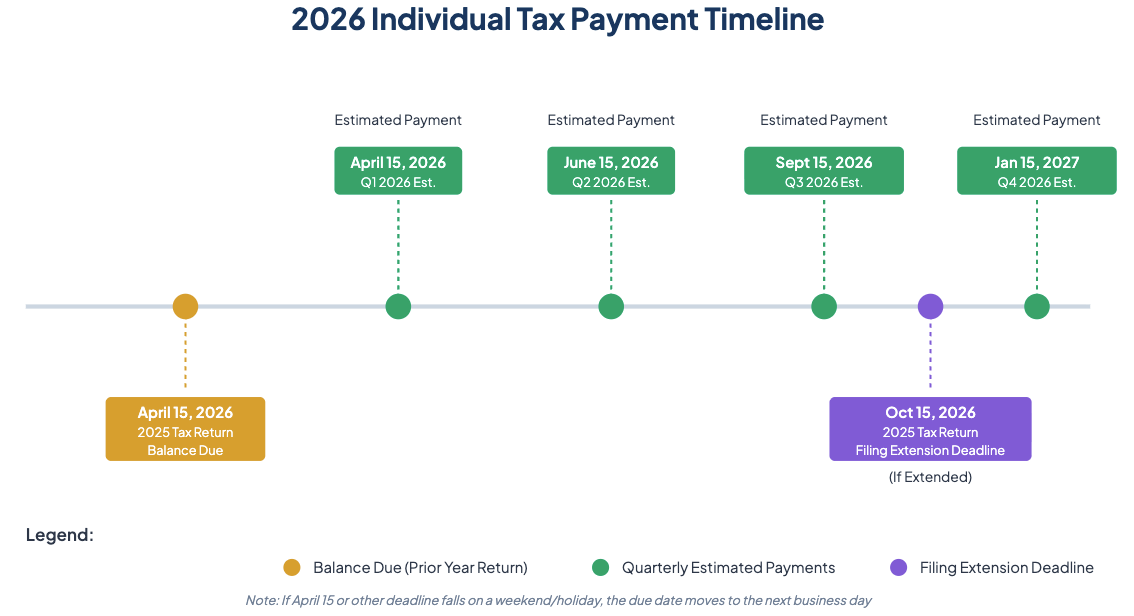
- April 15, 2026: Tax filing deadline (or request extension); Q1 2026 estimated payment due; payment for 2025 tax liability due
- June 15, 2026: Q2 2026 estimated payment due
- September 15, 2026: Q3 2026 estimated payment due
- October 15, 2026: Extended filing deadline
- January 15, 2027: Q4 2026 estimated payment due
Who Usually Extends Their Return?
Extensions are common when necessary information is incomplete or unavailable. The most frequent filers of extensions are taxpayers who hold an interest in private "pass-through” entities such as S-Corporations or partnerships. Their individual tax return depends on the prior completion of the corresponding business return, which allocates the information shareholders need to report.
Business owners aren't the only ones who extend. Sometimes gathering documents is time-consuming, and sending everything to your tax professional isn't always a priority early in the year. Since filing an extension has little to no barrier, it can be a smart choice. By extending, taxpayers and their professionals can reduce the risk of error by taking more time to collect complete information and verify return outputs.
Benefits of Filing an Extension
Filing an extension alone isn’t generally viewed as a red flag, and shouldn’t increase the likelihood of a tax audit, although the IRS may select returns for many reasons. Here are two reasons why filing a tax extension may be beneficial:
Reduced Risk of Errors
One reason many tax professionals suggest extending is to gain a better understanding and level of assurance that the details captured in the return are accurate. Taking more time helps avoid errors or potential misstatements that could eventually lead to IRS scrutiny.
Statute of Limitations Considerations
One consideration: the statute of limitations extends an additional six months if you extend rather than file timely. However, this additional exposure should not preclude taxpayers from filing later in the year. The likelihood of audit is not impacted, and a rushed, inaccurate return could lead to worse outcomes than an extended but accurate one.
The Bottom Line
Extending your tax return deadline until October 15 is a valuable option utilized by millions of taxpayers each year. It should be viewed as a prudent strategic choice, not a last resort. Extending the time to file carries no penalty, provided you accurately estimate and pay any tax owed by the April deadline.
Whether you're a business owner awaiting essential financial documents or simply need more time to gather your information, an extension grants you the necessary breathing room to ensure accuracy. By reducing the risk of errors that can arise from rushed or incomplete filing, extending your return promotes both confidence and compliance.
Disclosure:
The information contained in this communication is for informational purposes only. This content may not be relied on in any manner as specific legal, tax, regulatory, or investment advice. While we strive to present accurate and timely content, tax laws and regulations are subject to change, and individual circumstances can vary.
You should not rely solely on the information contained here when making decisions regarding your taxes or financial situation. We strongly recommend consulting with a certified tax professional, accountant, or legal advisor to address your specific needs and ensure compliance with applicable laws.
This article focuses on U.S. federal individual returns; state deadlines and rules may differ. Some taxpayers (e.g., living abroad) may have different deadlines.
Tax services by Range Tax, LLC. For more information about Range Tax’s services, fees, and disclosures, please visit range.com.




.svg)
.svg)
.svg)

