


With the first month of Q3 behind us and earnings season nearly complete, we sat down with our Chief Investment Officer, Taresh Batra, to take stock of positioning, fundamentals, and the market's outlook from here.
Q: We've had a turbulent start to Q3. Semis were down over 20% last month and the Nasdaq went into correction territory. What's your take on the volatility we've seen so far?
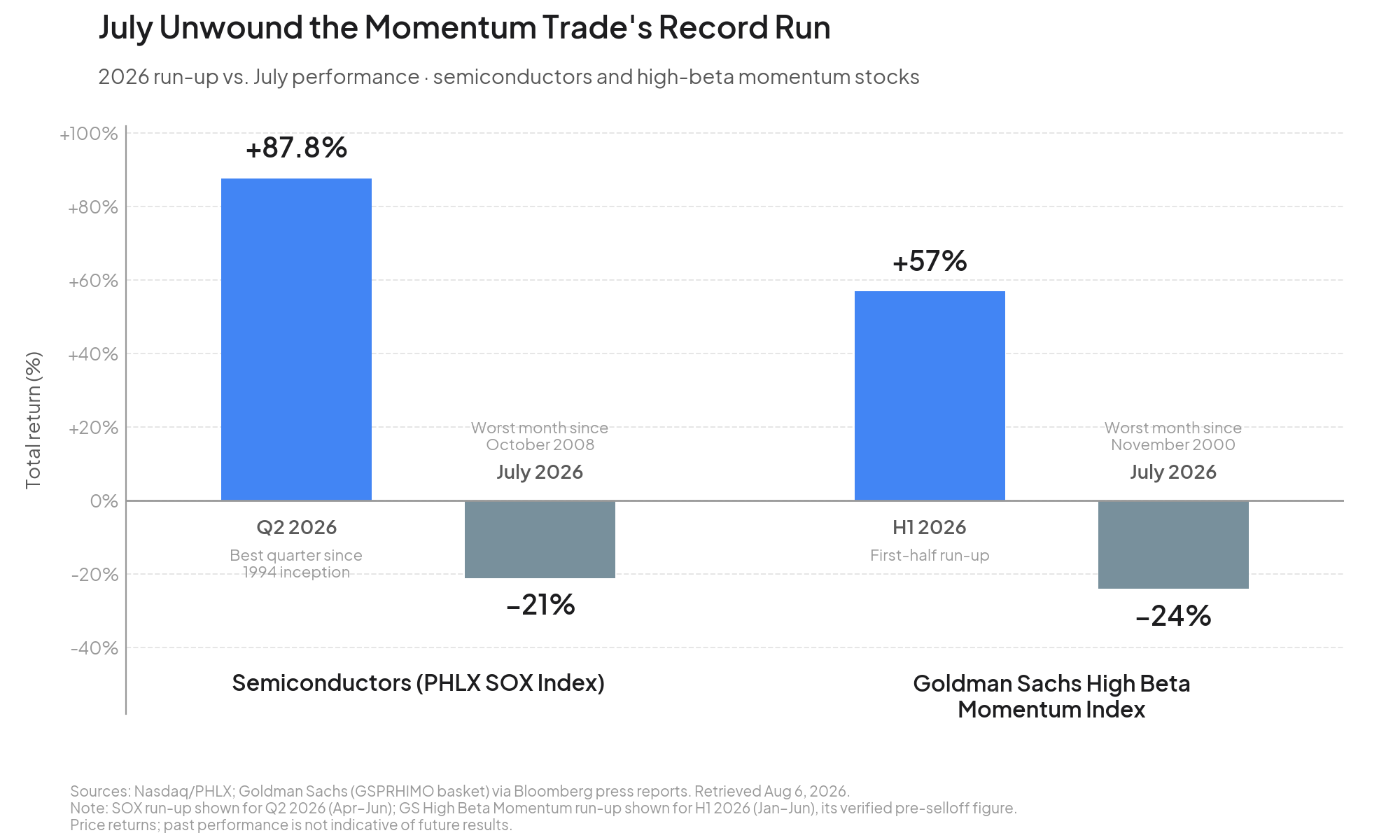
We have to remember the setup coming into the quarter. Q2 was the market's best quarter since 2020. Momentum stocks were flying high, and semiconductors were coming off their best two-month run on record in May and June.
We were encouraged that these returns were primarily driven by robust fundamentals, but cautioned that we were beginning to see signs of excess: increasing leverage and dangerously concentrated positioning.
In July, a lot of that excess unwound. Momentum stocks stumbled, with Goldman's High Beta Momentum index falling nearly 25% in the month. Semis fell 21%, their worst month on record.
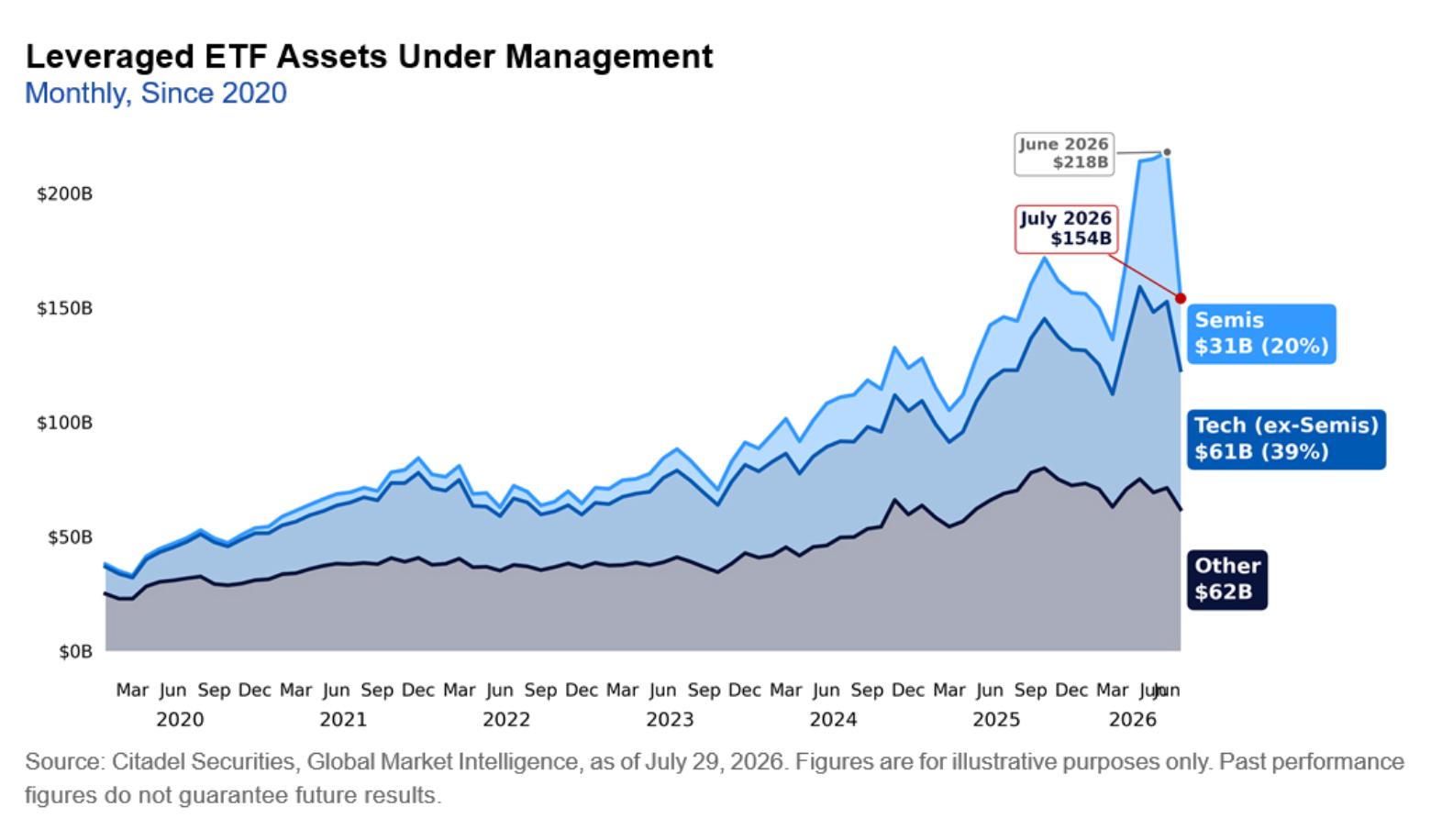
But amidst the pain, technicals have reset in a positive direction. Levered ETF assets are down meaningfully since their June peak, especially in semis and tech. Retail interest in highly speculative themes has faded; according to Citadel Securities, option activity in areas like quantum, crypto and rare earths was down 70-80% in July.
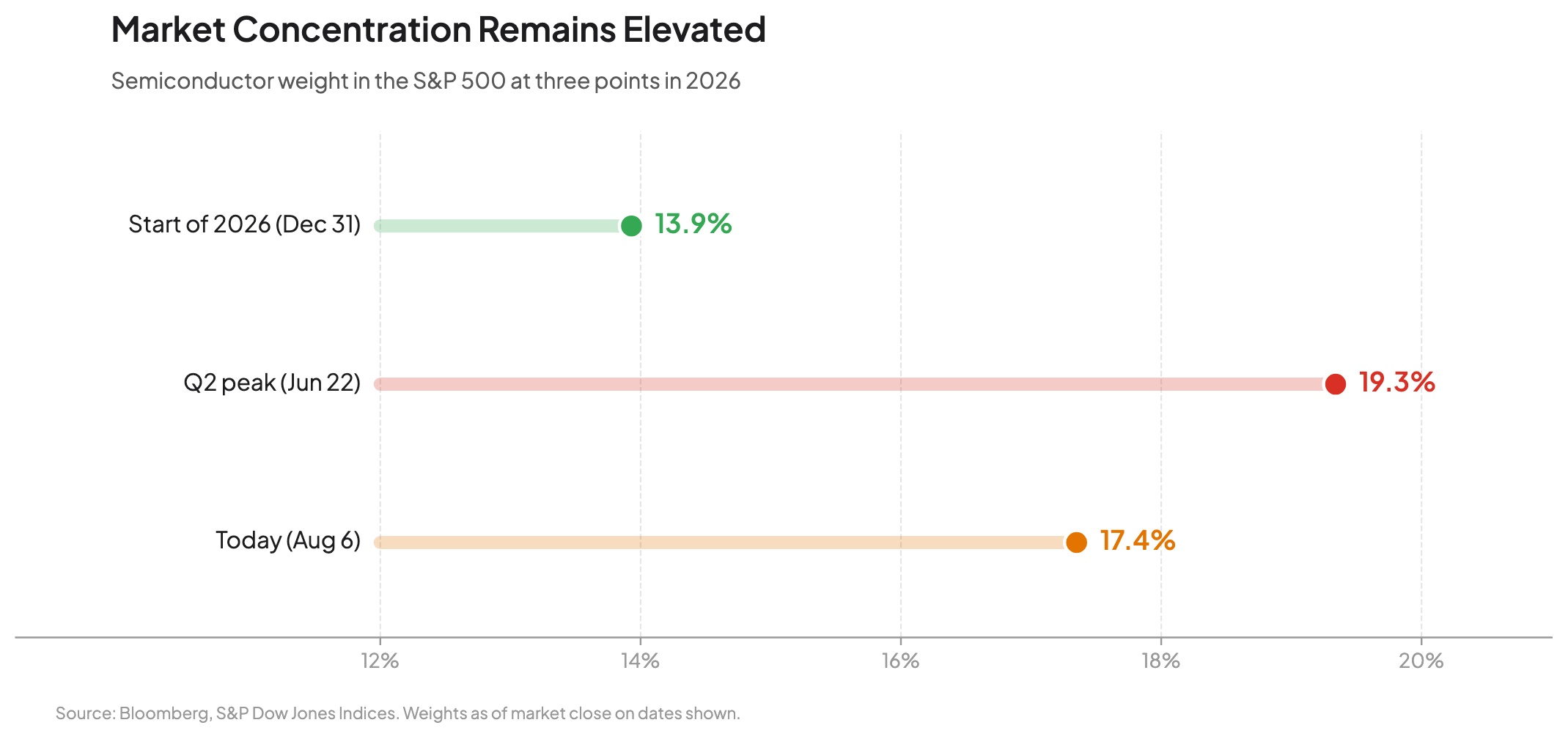
Market concentration has also improved, albeit only modestly. Semis now make up 17% of the S&P 500, down from a high of over 19% in Q2. While we've seen some rotation in leadership, the largest 10 companies still dominate the index.
Excess in the system may not be fully fleshed out, but we have a healthier backdrop today than we did entering Q3. We're starting to get to a point where we can revert our focus back to fundamentals.
Q: Now that positioning is less of a headwind, how do fundamentals look? Are you still constructive?
Whether looking top-down at the broader economy or bottom-up at individual companies, the fundamental backdrop continues to appear very healthy.
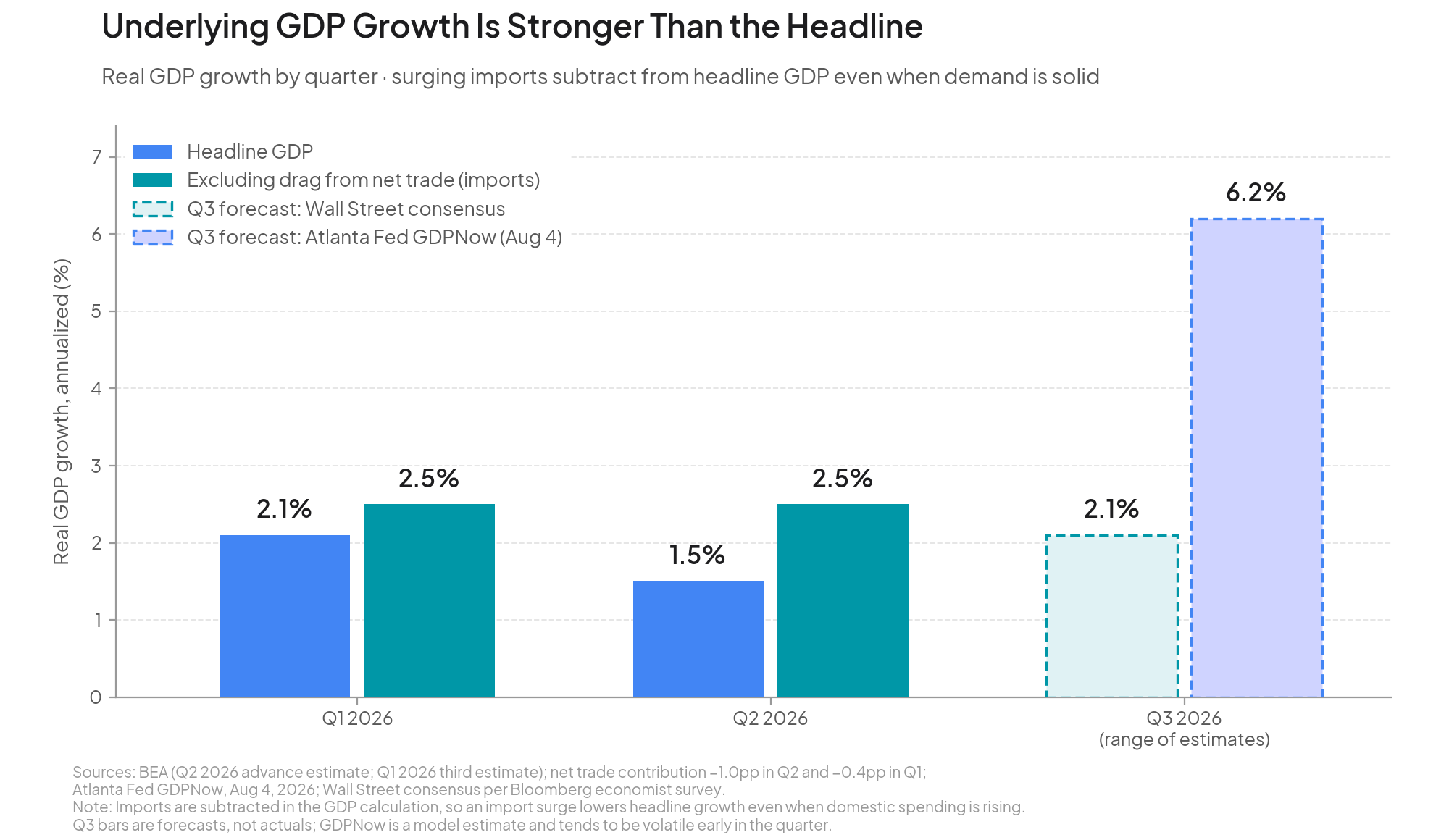
Top-down, headline U.S. GDP growth of 1.5% in Q2 seems tepid, but that number is dragged down by the import-computation methodology. Excluding the drag from higher imports, GDP growth in Q2 was 2.5%, stable vs. Q1. Economists are forecasting GDP growth to accelerate in Q3.
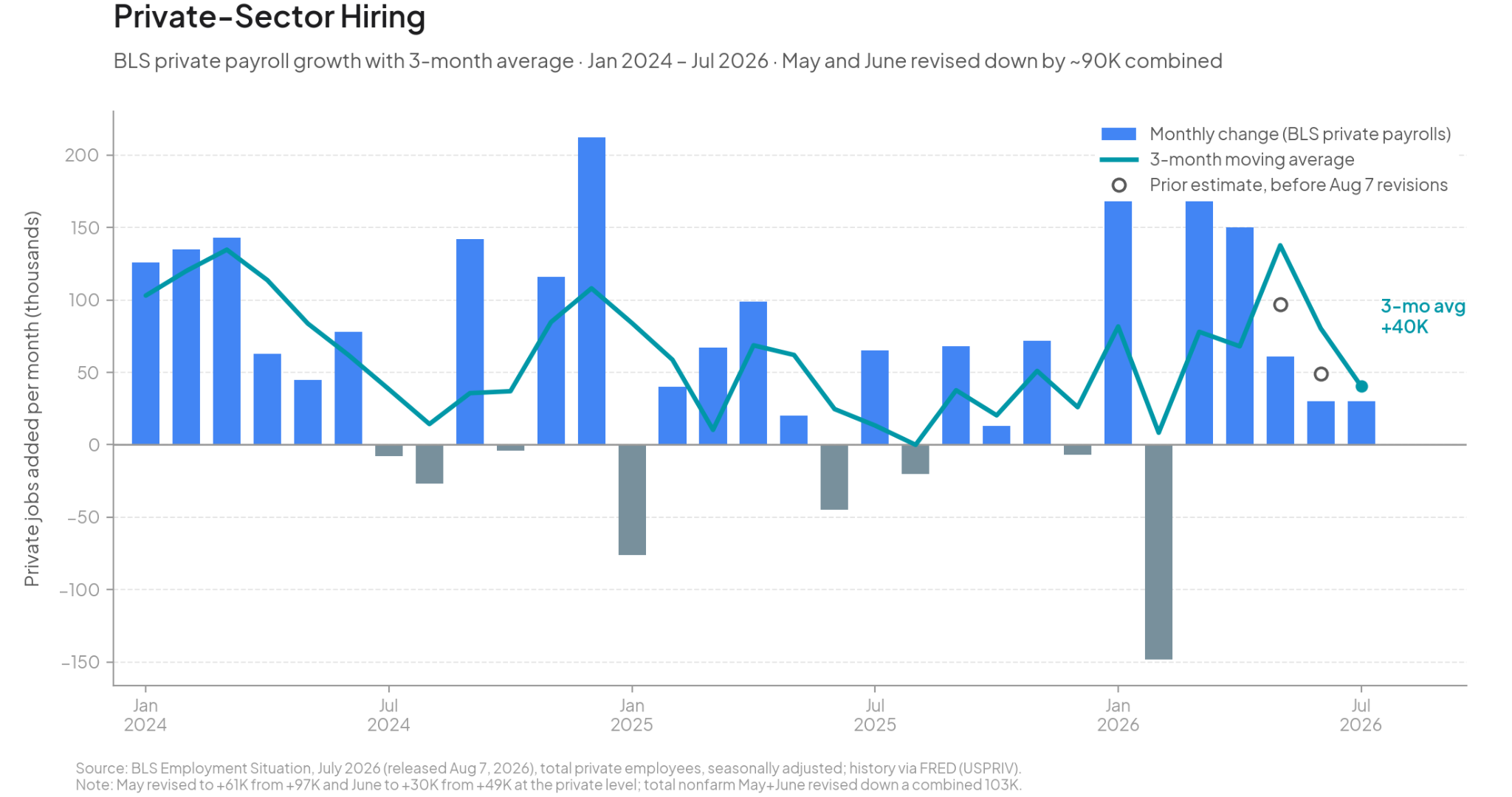
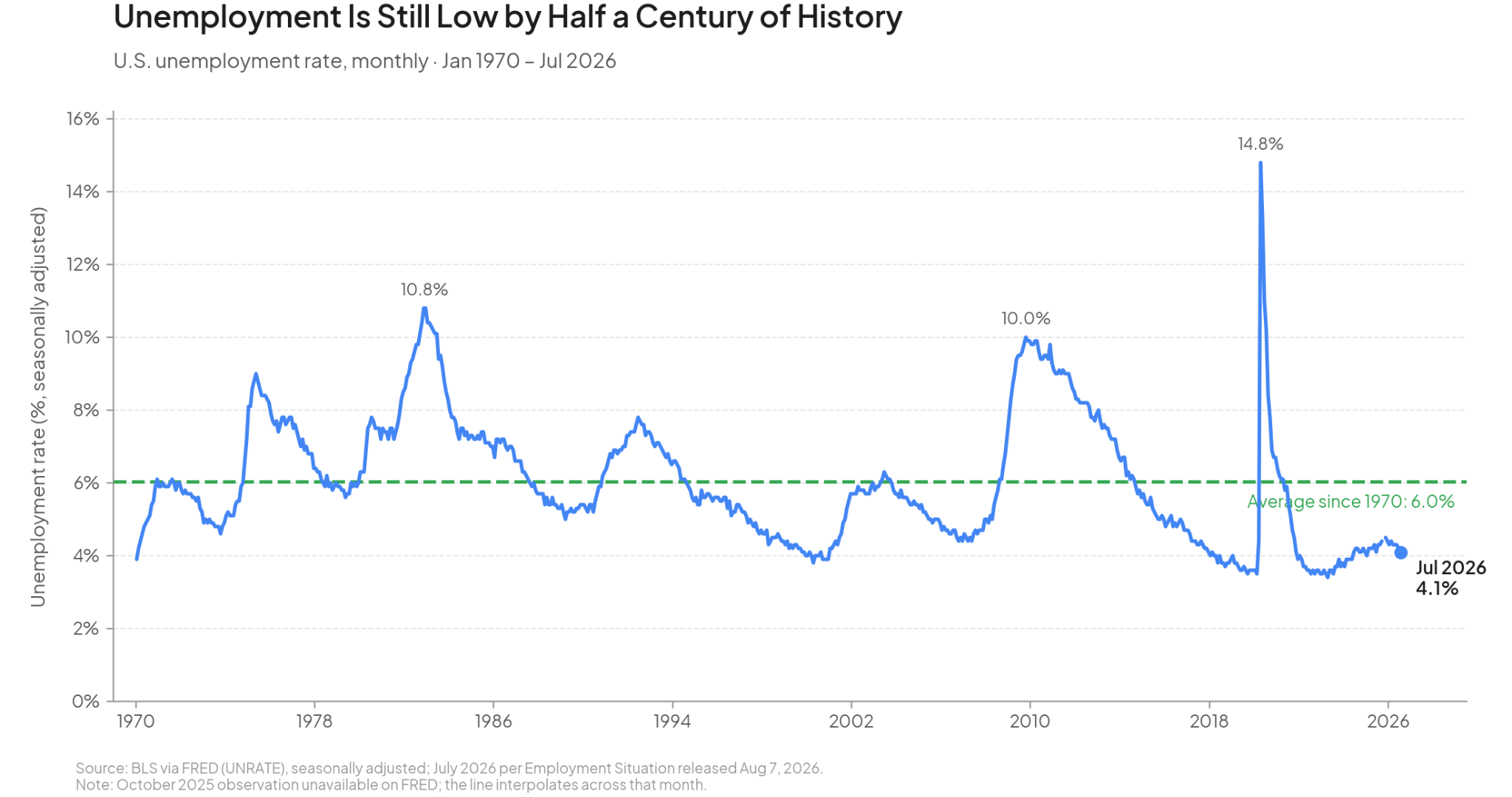
Friday's jobs report for July indicated some softness in the labor market as private payrolls increased only 30,000 and the prior two months were revised sharply lower. In our view, this dataset's volatility and heavy revisions make any single report less reliable. The labor market appears generally stable — not too hot, not too cold. The unemployment rate remains low relative to history at 4.1%.
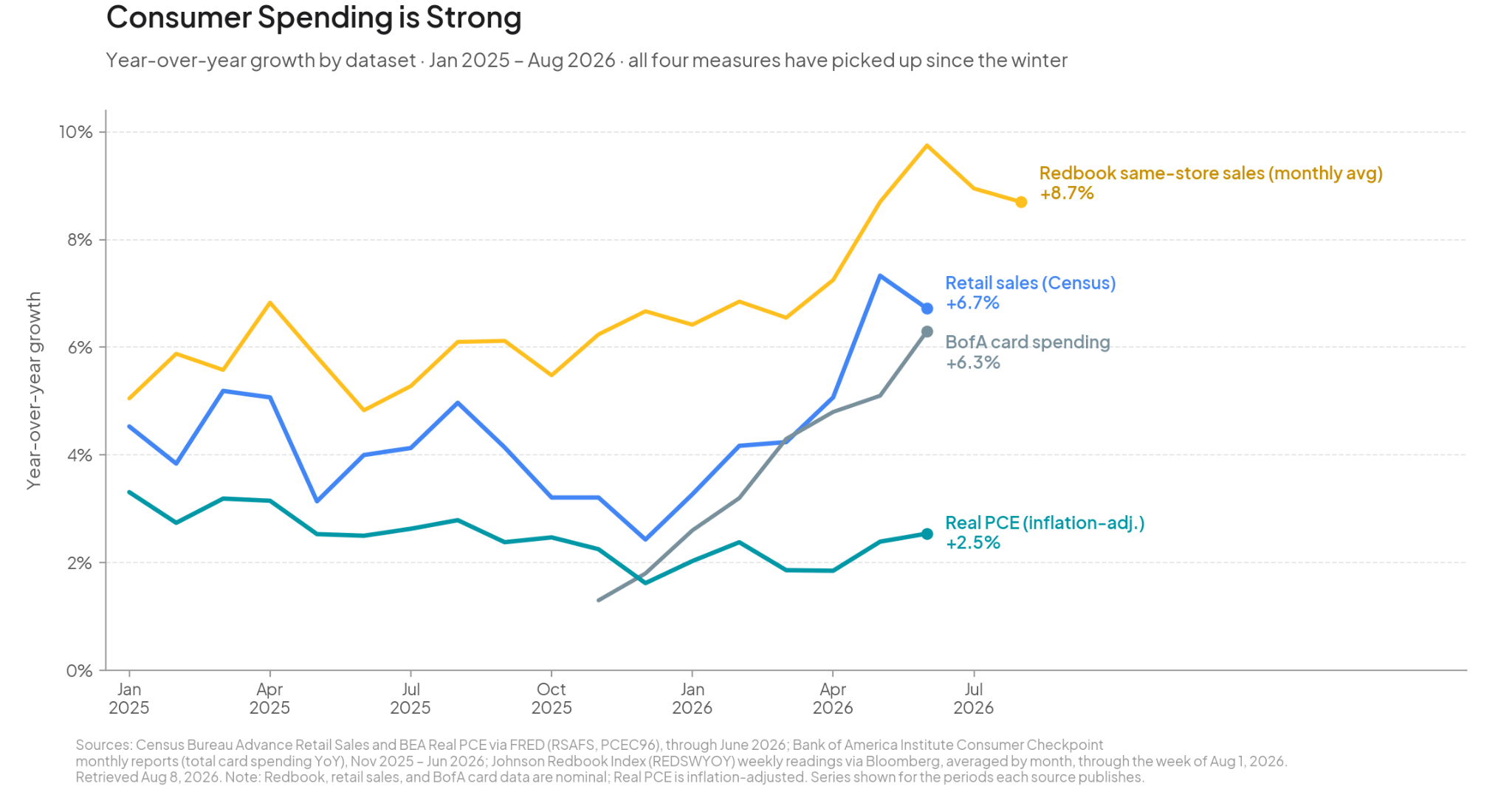
Consumer spending, which accounts for nearly 70% of GDP, remains strong by virtually every measure and has gained momentum in recent months.
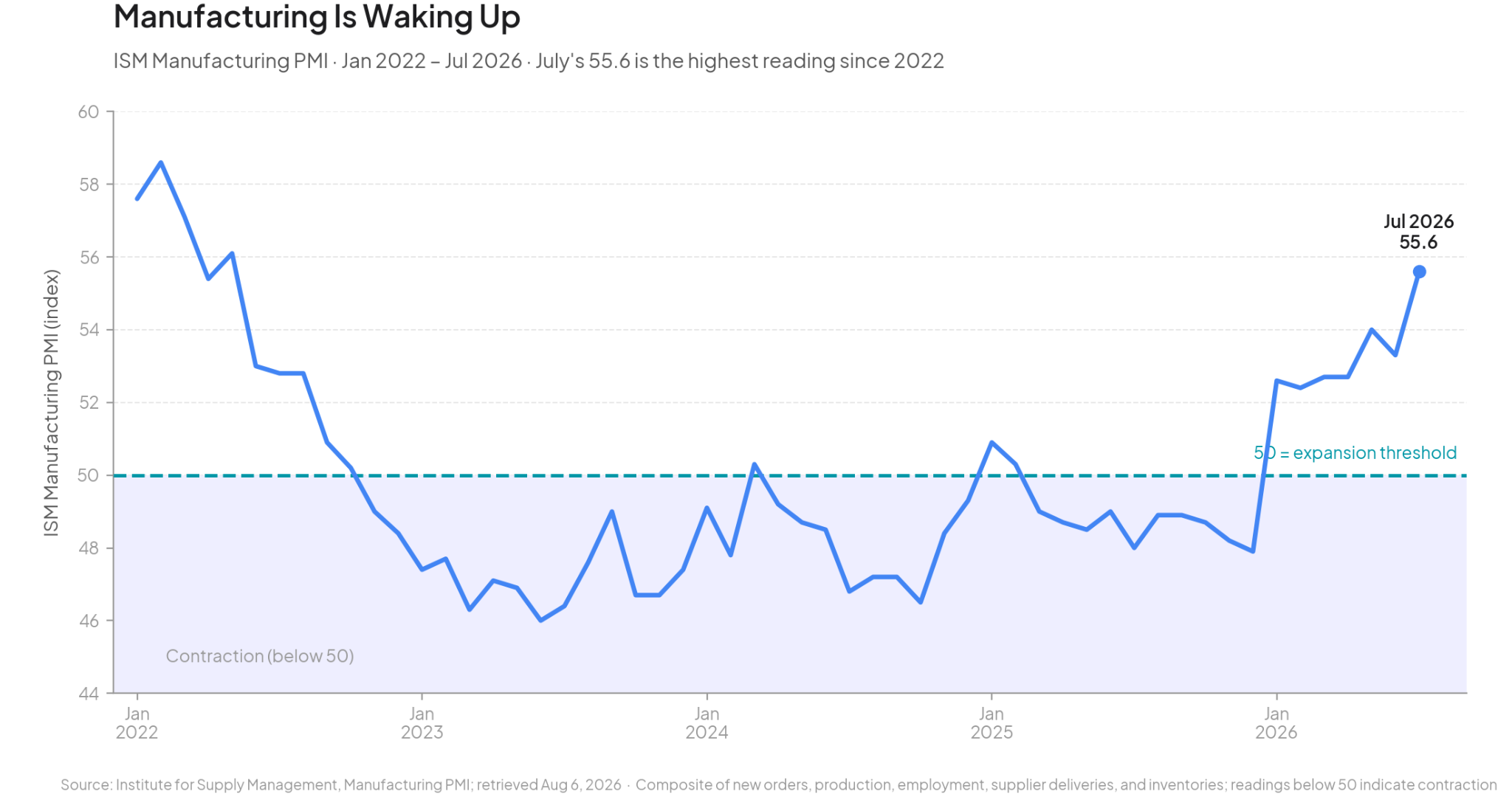
The industrial economy is also accelerating. At the beginning of this year, we noted our view that the industrial economy was earlier in the economic cycle than many may realize. Coming into 2026, ISM Manufacturing PMI — a monthly survey of purchasing managers that tracks activity across the manufacturing sector — had been in contractionary territory for 35 of the 38 preceding months. After inflecting toward expansion in January, the index accelerated to 55.6 in July, the highest reading since early 2022.
We believe the data collectively point to a resilient economy, with pockets of acceleration emerging as we enter the second half of the year.
Q: How is this translating to earnings performance?
Macroeconomic data is solid, but earnings performance has been exceptional. After a historic earnings season in Q1 where earnings grew nearly 30% for the S&P 500, Q2 earnings are shaping up to be even more impressive.
Nearly 90% of the way through earnings season, S&P 500 companies are reporting average earnings growth of nearly 52%. A big chunk of this is driven by Amazon and Alphabet earnings benefiting from unusually large gains from their equity stakes in private companies like Anthropic. However, even after excluding Amazon and Alphabet, the blended earnings growth for the S&P 500 is nearly 30%, in line with Q1's impressive performance.
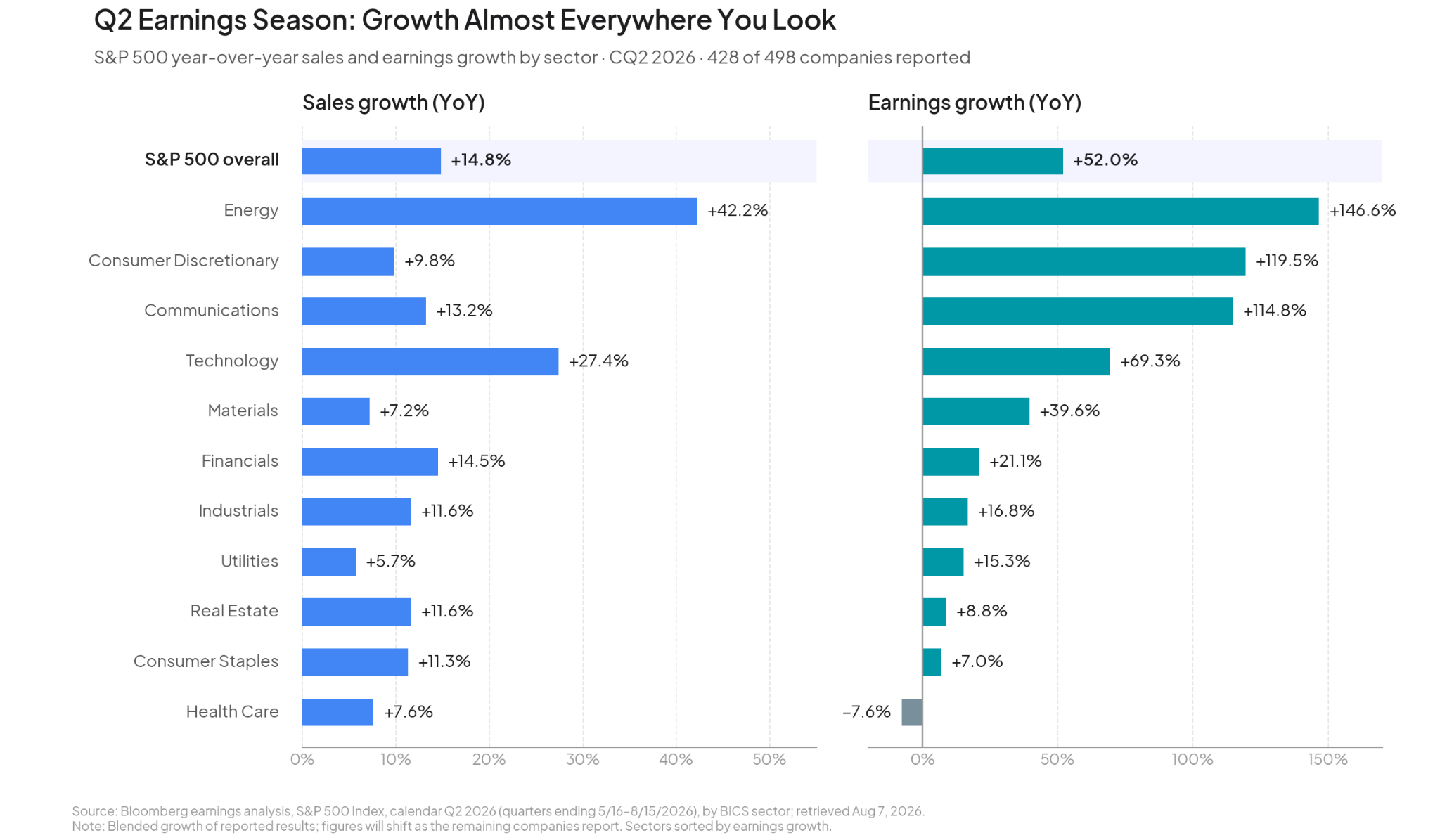
Importantly, earnings strength continues to be broad-based, with 8 of 11 sectors reporting double-digit earnings growth for Q2.
Q: Earnings have largely been driven by AI. Where are we in the AI cycle?
With big tech earnings behind us, the AI investment cycle appears firmly intact.
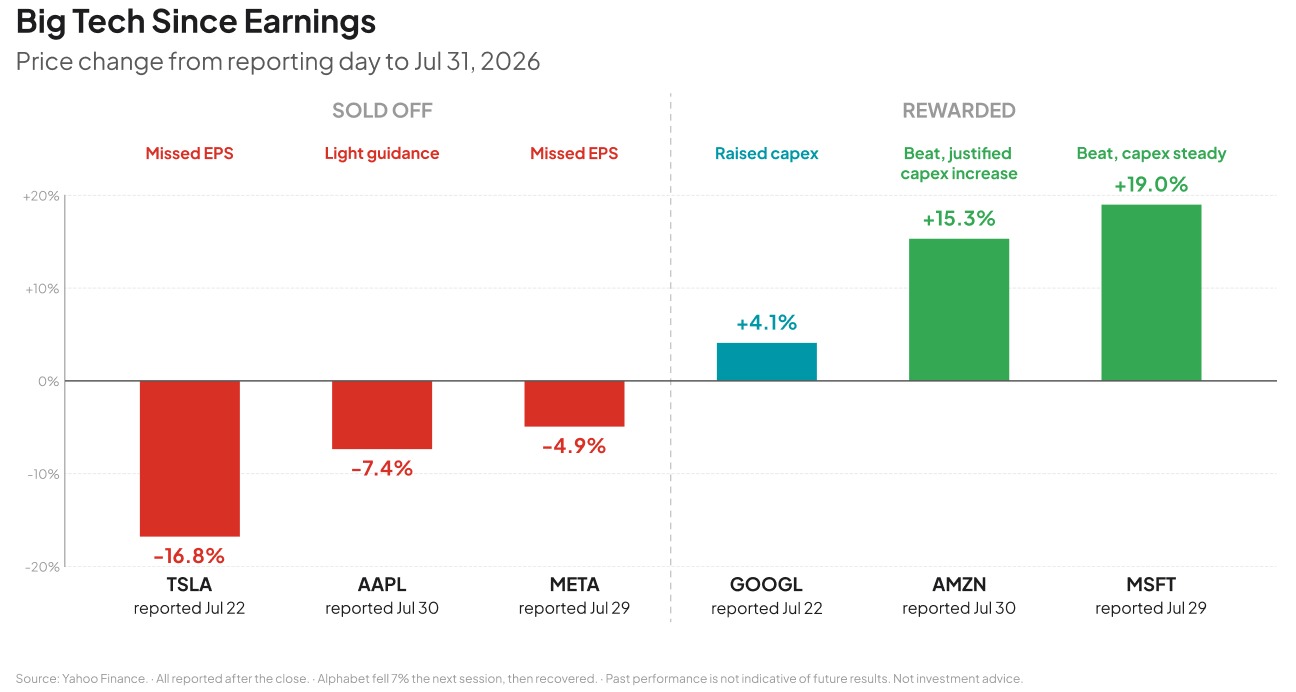
The biggest spenders, including Google, Amazon, and Meta, raised their capex outlooks again in Q2. The more important development is on the revenue side. Cloud growth is accelerating, which is the clearest evidence yet that this investment is generating returns.
.jpg)
We believe a key driver is the shift in AI usage from simple queries to complex, agentic workflows. AI usage is moving from "explain this" to "do this." That shift is far more compute-intensive. While a chatbot answers a question and stops, an agent breaks a task into steps, calls other software tools, checks its own work, and keeps running. Every step consumes tokens, the units of computing that cloud providers sell.
According to Goldman Sachs, a single agentic task consumes 10x to 50x the tokens of a standard chatbot request. They forecast token consumption will grow 24x from 2026 to 2030. Even then, they estimate only 12% of knowledge workers will be using agents, a figure they see reaching 37% by 2040. Penetration is early, and the runway looks long.
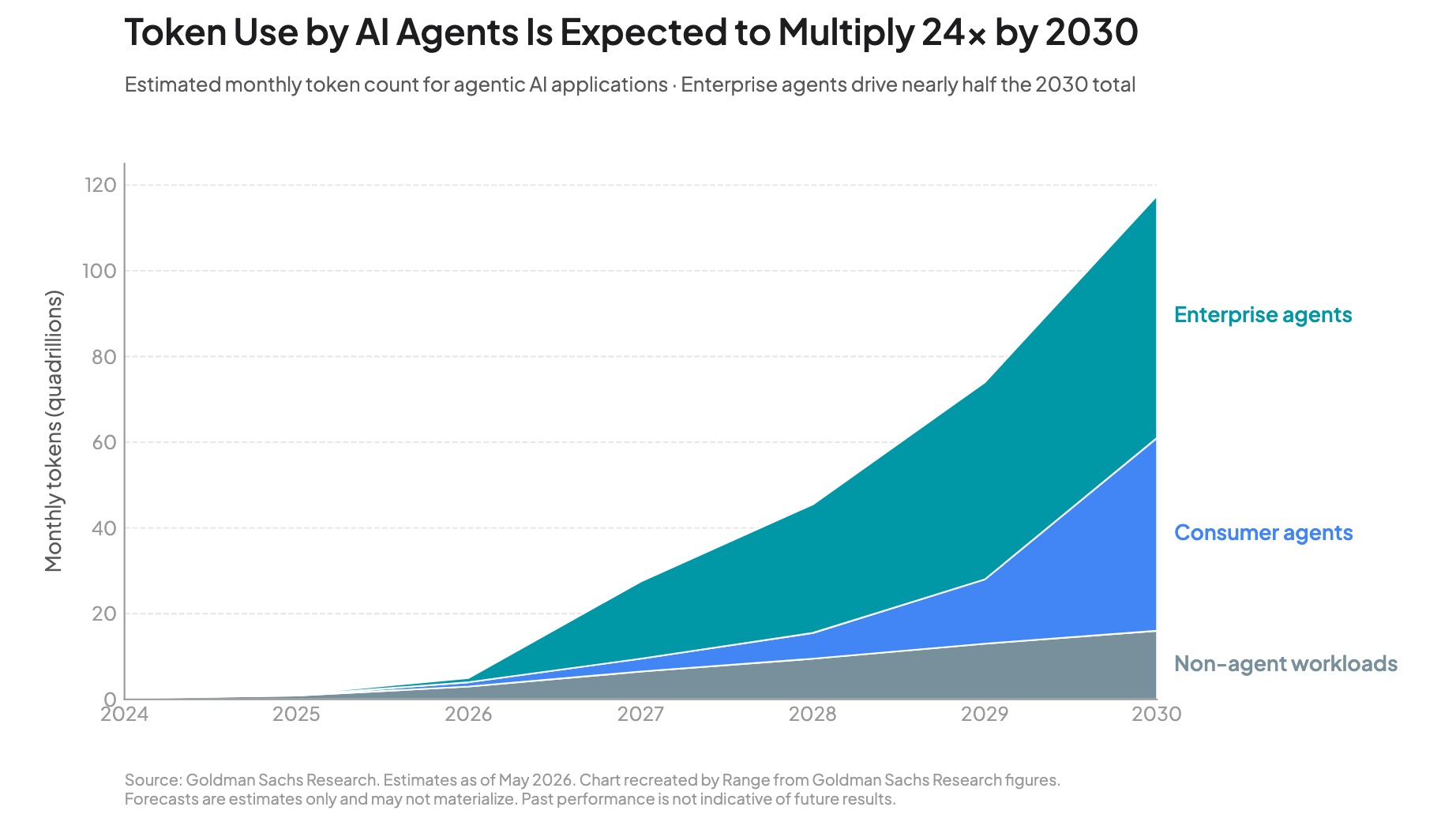
Costs are falling as fast as usage is rising. The cost of computing per token is declining an estimated 60% to 70% per year, and spending may shift toward cheaper models over time. This may pressure some parts of the ecosystem, but on balance, we believe falling costs accelerate adoption and allow broader participation in the benefits of AI, the same pattern that played out with prior computing cycles.
While we still see room to run in the AI cycle, the reaction to Q2 earnings demonstrates investors are not blindly greenlighting AI investment and increasingly want evidence of disciplined capital deployment and tangible returns.
Q: What about valuations? You had mentioned at the end of Q2 that valuations were creeping up; is the market too expensive?
Despite the index reaching another all-time high this week, the S&P 500's valuation is down slightly since the end of Q2 from 20.3x to 19.9x forward P/E. This is right in line with the index's 5-year average despite earnings growth being well above average.
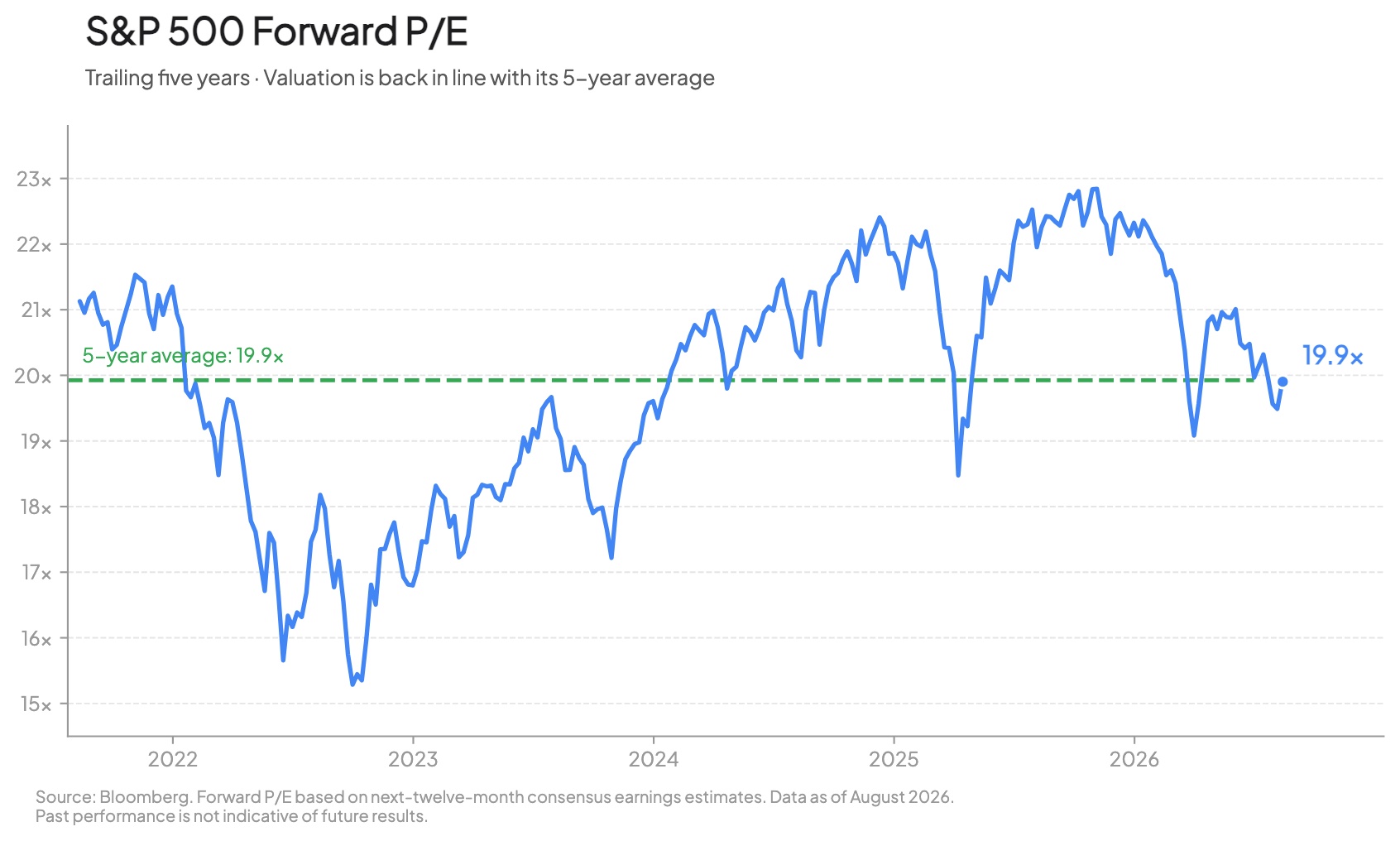
Valuations for the average stock look even more reasonable. The equal-weighted S&P 500, which treats every company equally regardless of size, is trading at 16.6x forward P/E, right in line with its 5-year average.
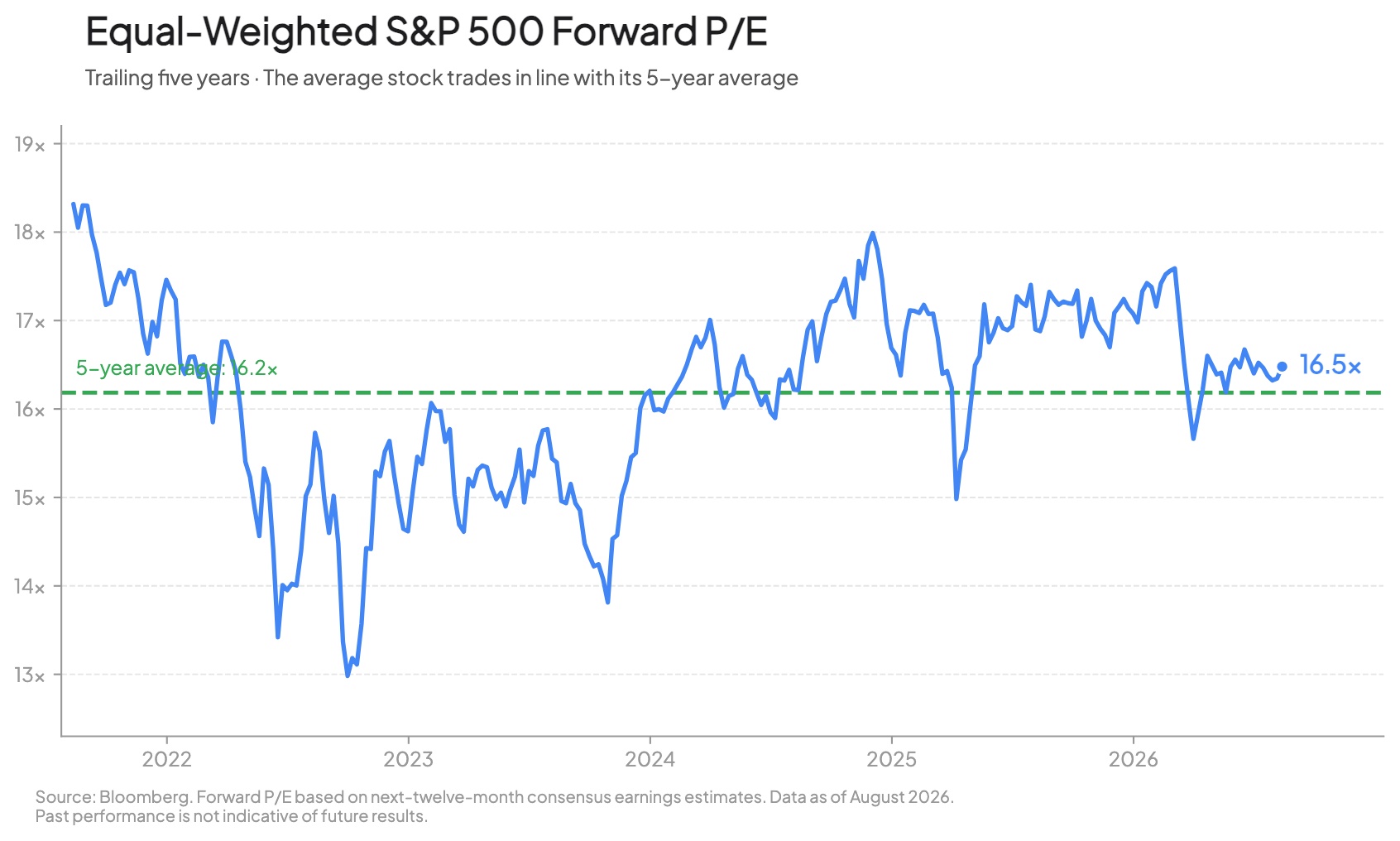
Importantly, valuations in some of the best-performing sectors continue to compress. The tech-heavy Nasdaq index is now trading at 22x, vs 23x at the end of Q2 and its 5-year average of 25x. While we often hear tech-bubble comparisons in the media, it's important to note that the Nasdaq's valuation reached an eye-popping 80x P/E in 2001.
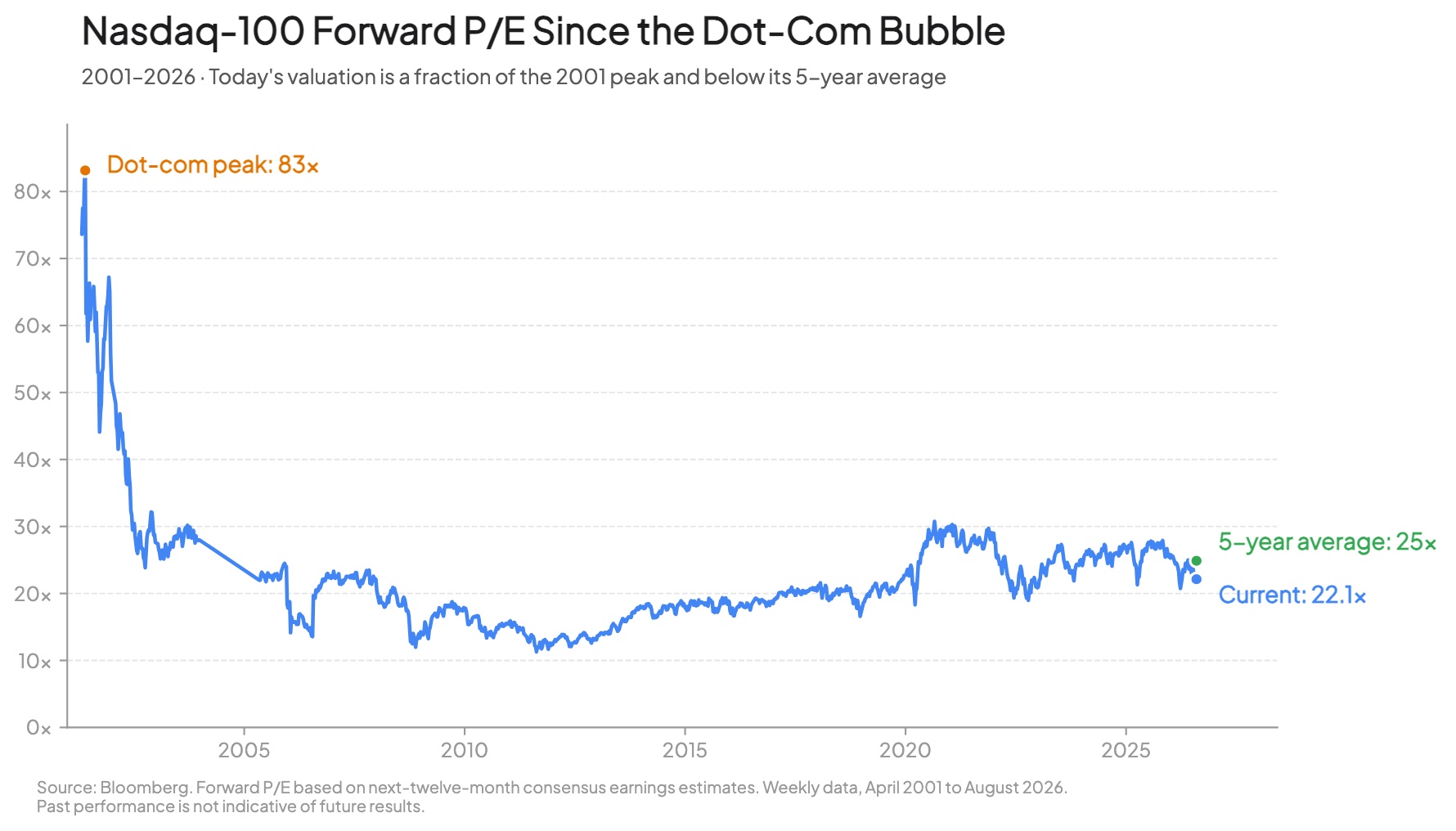
Overall, we certainly wouldn't characterize valuations as "cheap", but they are squarely within historical averages and well below prior peaks. We continue to think stock performance will be driven by earnings growth rather than valuation expansion, which is what we've seen for the last several quarters.
Q: What about risks to the market? We still don't have a resolution in Iran, and you've warned it'll be hard for the economy to withstand a sustained oil shock.
So far, the global economy has been much more resilient than many expected in the face of the closure of the Strait of Hormuz.
We believe that resilience comes down to a few factors:
- We entered the conflict with excess supply and significant inventories. Since then, strategic reserves have been drawn down to help offset the disruption.
- Some oil is still leaving the Gulf through alternative routes, including pipelines.
- Most importantly, China has quietly reduced oil demand by as much as 5 million barrels per day.
The problem is that each of these offsets has a limited runway.
It's unclear whether China can reduce demand further or how long it can sustain demand at these lower levels. Strategic reserves are finite. Some of the alternative routes being used to move oil out of the region are also vulnerable to attack by Iran or its proxies.
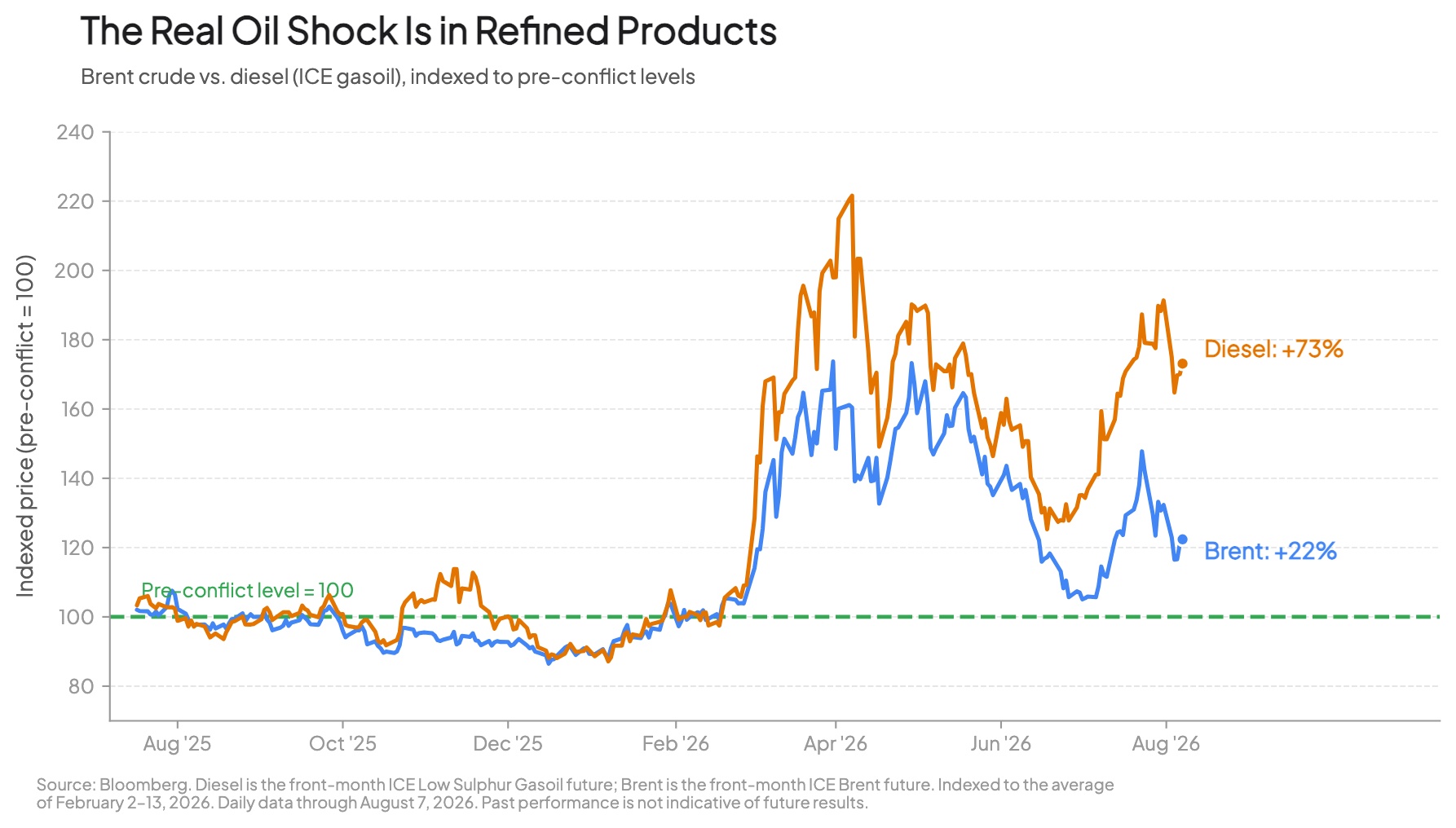
That risk is not fully reflected in the headline price of crude. Brent is up about 22% from pre-conflict levels, but diesel is up roughly 73%. In other words, the real oil shock is showing up in refined products, which are more directly tied to transportation costs, industrial activity, and the prices businesses and consumers ultimately pay.
As long as traffic through the Strait remains constrained, that pressure is likely to continue. The global economy has absorbed the initial oil shock remarkably well, but that resilience will be tested the longer the disruption persists.
Q: You've focused a lot on Fed policy at Range. Do you feel the next Fed move poses a risk or opportunity for the market?
At Range, we are staunch watchers of the Fed. We believe Fed policy has been a critical driver of market performance over the past two decades, especially during and after periods of crisis, like the Great Recession or the COVID pandemic.
However, given the economic landscape, we aren't currently in a crisis. Last week, we argued that the current environment is one where Fed policy may (at least temporarily) take a backseat to other market drivers, most notably, the exceptional earnings growth we're currently experiencing.
More than modest hikes of the Fed Funds rate, which we think the economy can withstand, we are concerned about the trajectory of long-term rates, which are set by the market and sit near multi-decade highs. These influence everyday expenses such as mortgage rates, student loans, and auto loans.
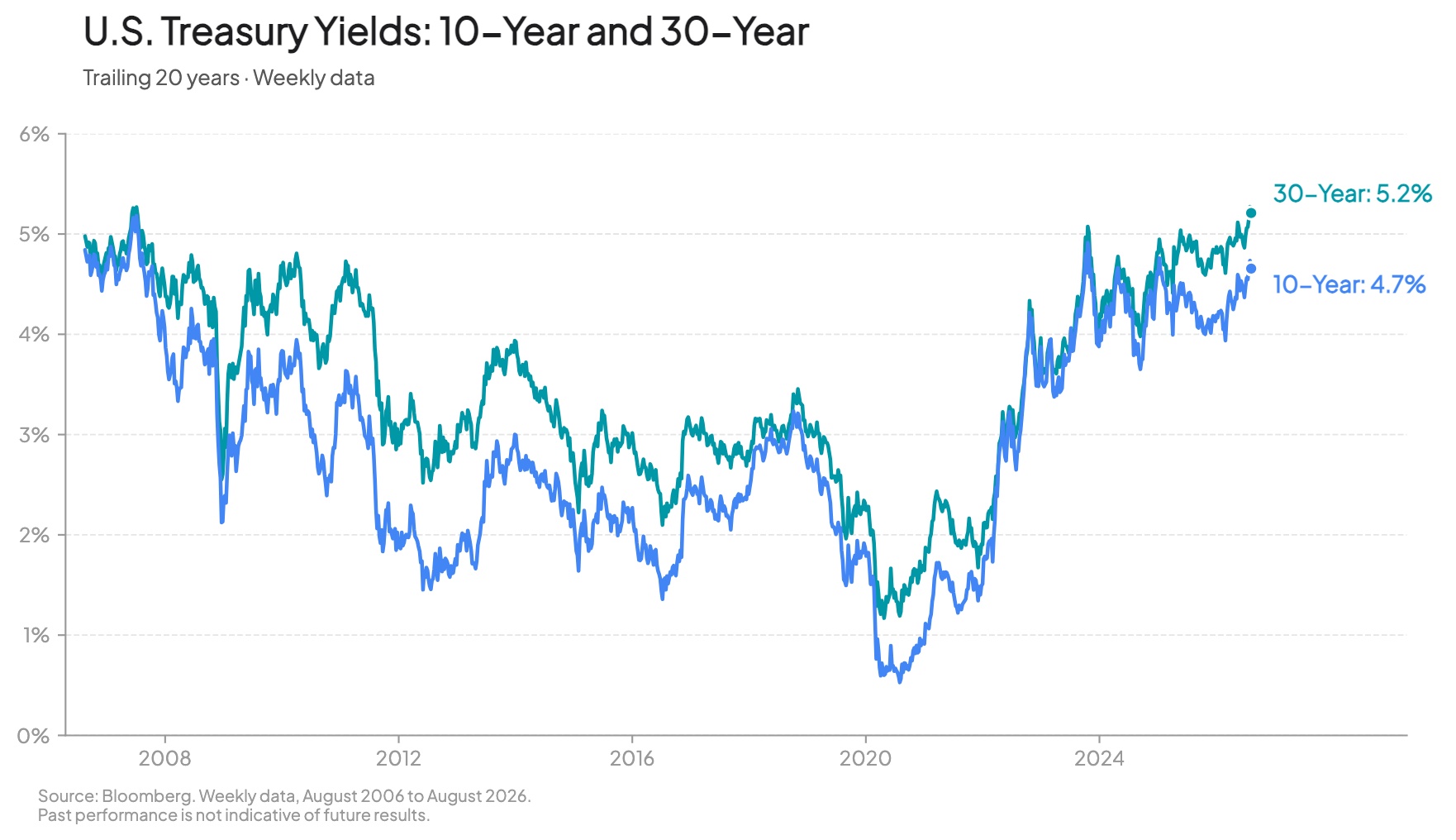
Continuously growing deficits and a perceived lack of resolve by the Fed to bring inflation lower are contributing to the rise in long-term rates. Simply put, investors are demanding more compensation to hold US Treasury securities for the long term.
If these rates continue moving higher, they could pose a meaningful risk to the equity rally. While the market has proven it can still perform well with the 10-year around 4.5%, we believe a move towards 5% would be much harder to digest.
Q: How are you thinking about the balance of 2026? What should investors be prepared for?
We remain constructive, because fundamentals are intact: the economy is resilient, the AI cycle has room to run, and earnings are compounding at exceptional rates.
That said, there are real risks to consider. Valuations, while reasonable, aren't cheap. Long-term rates already sit near multi-decade highs, and moves higher may be difficult for markets to digest. The oil shock remains unresolved, and the offsets containing it may have limited runway. Positioning, while healthier than it was in June, hasn't fully reset. Leverage and speculative appetite can rebuild quickly in a rising market.
.png)
For investors, our guidance follows principles that are battle-tested. Stay diversified —July punished concentrated portfolios while diversified ones barely felt it; the S&P 500 was roughly flat in a month when semis fell 21%. Be wary of excess leverage. It amplifies both directions, and markets reprice faster than most investors can react. And use volatility to your advantage rather than trying to sidestep it: harvest losses when they appear, rebalance when your portfolio drifts, and stay invested.
It's hard to be bearish when profits are growing 30%, but it's precisely in strong markets that discipline is easiest to abandon and most valuable to keep. Expect more months like July on the way to what we believe are higher highs, and make sure you have a plan that's built to withstand them.
Disclosures:
This communication contains forward-looking statements that reflect Range Advisory, LLC’s (“Range”) current views, expectations, beliefs and/or projections about future events or results. Forward-looking statements involve risks and uncertainties — including, without limitation, market conditions, regulatory changes, economic conditions — any of which could cause actual results to differ materially from those expressed or implied by such statements. Range undertakes no obligation to update or revise any forward-looking statements to reflect new information, future events or otherwise, except as required by law. Recipients should not place undue reliance on forward-looking statements, which are presented for informational purposes only and do not constitute investment advice or a recommendation to buy, hold, or sell any security. Past performance is not indicative of future results. The views, opinions and analyses expressed by Range in this material are those of Range as of the date shown, and are provided for informational purposes only.




.svg)
.svg)
.svg)

