


As we step into 2026, the fundamental backdrop for markets appears more favorable than anything we’ve seen since 2021. It may be hard to remember after wrapping up a strong year for global markets, but investors climbed a significant wall of worry throughout 2025. Policy uncertainty dominated headlines: Would DOGE trigger a recession? Were we heading into a trade war? Would the Fed prioritize fighting inflation or supporting the markets?
Many of these questions have been answered, and two powerful forces are now working in investors' favor: policy clarity and Federal Reserve support.
The Macro Reset: Policy Fog Has Lifted
Investors hate uncertainty more than they hate bad news. Throughout 2025, we faced three major policy unknowns that froze decision-making and weighed on markets. Now, we finally have answers.
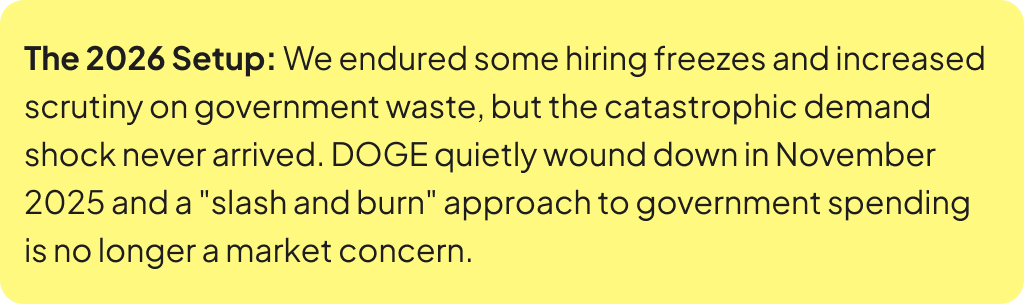
The Fear of "DOGE"
Following the creation of the Department of Government Efficiency, headlines suggested a staggering $2 trillion in immediate spending cuts. Markets worried we were at risk of "shock therapy" that would trigger a government-induced recession.
The Tax Cliff
The looming expiration of the Tax Cuts and Jobs Act created a massive overhang at the beginning of 2025. CFOs froze spending plans and M&A slowed, as it was difficult to model returns on investment without knowing tax policy.

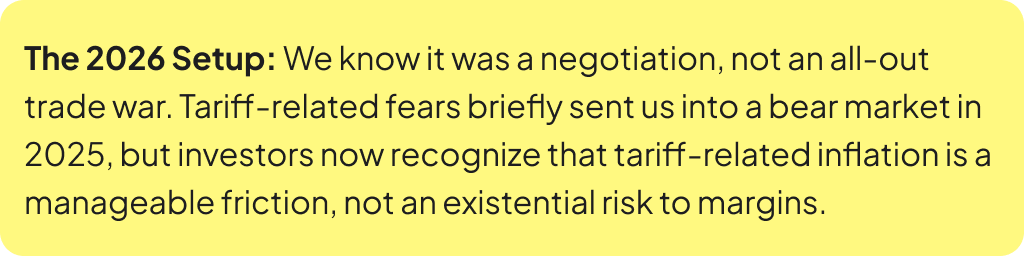
Tariff Russian Roulette
Perhaps the most traumatic policy risk of 2025 was trade rhetoric that seemed to escalate daily. Threats of 100% tariff rates became a regular occurrence, and investors feared an extreme universal tax that would reignite 1970s-style stagflation.
The Fed Has Shown Its Cards: Support, Not Restraint
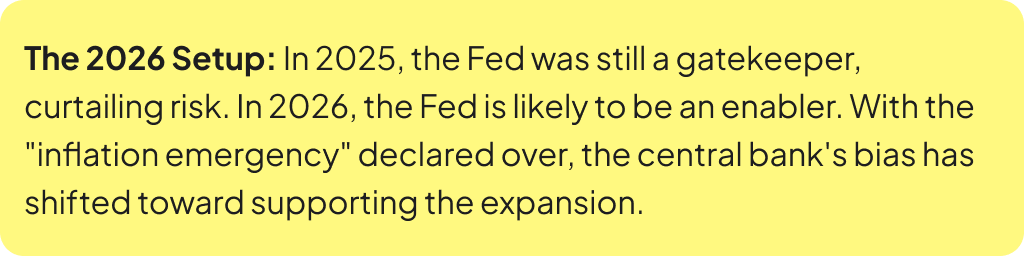
More than fiscal policy, valuations, or even earnings, we believe the most important variable for markets is the Federal Reserve. In 2026, the Fed appears ready to shift from fighting inflation to protecting expansion, acting as a powerful backer for markets.
For the first time since 2021, we are seeing the Fed is use both of its primary tools to support asset prices:
1. Lowering Short-Term Rates
The Fed cut rates three consecutive times through December, bringing the target range down to 3.50%–3.75%. This directly stimulates economic activity.
2. Ending Quantitative Tightening
Perhaps more importantly, the Fed quietly ended Quantiative Tightening (QT) on December 1st. For two years, the Fed drained liquidity from the financial system every month by letting bonds roll off its balance sheet. It was a silent headwind for risk assets. By stopping this runoff, they’ve removed a structural drag on markets.
The Pivot: A Real-Time Case Study
The impact of the Fed on market performance is hard to overstate. When the Fed started to sound hawkish in late October, our investment team went on alert. The market proceeded to struggle for weeks. After a noticeable dovish pivot in Fed-speak in late November, the markets were able to resume their upward trajectory.

The Outlook For 2026 – A “Risk On” Backdrop
With clarity comes confidence. We expect 2026 to be the year when the tangible benefits of a more pro-business policy mix show up in the data and support a broader universe of stocks. The “animal spirits” many expected in 2025 may finally emerge—supported by policy clarity and a Federal Reserve that has shifted from restraint toward accommodation.
We expect this to translate into two supportive dynamics:
1. Wider Market Participation (Increased Breadth)
While megacaps drove index performance, the average U.S. company has struggled to grow earnings and invest with conviction. A key reason has been uncertainty: when tax policy and trade rules are moving targets, CFOs raise hurdle rates, delay capex, and keep balance sheets defensive. As that fog lifts, the beneficiaries should extend well beyond AI-linked winners—and toward the broader universe of domestic cyclicals, industrials, financials, and services businesses that are most sensitive to planning certainty.
Monetary policy also works with a lag, and in 2026 we expect corporations to feel the benefit of roughly 175 bps of cumulative rate cuts delivered since the easing cycle began. Further easing also seems likely—especially if we lap tariff impacts after Q1 and AI-driven productivity gains help keep inflation contained. Lower rates benefit small- and mid-cap stocks disproportionately, given higher leverage, greater cyclicality, and a heavier dependence on domestic demand.
2. Supported Valuations
Markets should benefit from an easing liquidity headwind as quantitative tightening by the Fed has ended. A less restrictive liquidity backdrop typically lowers the “hurdle rate” investors apply to future cash flows and reduces the extra return they demand to own equities. That doesn’t guarantee higher P/E multiples, but it does raise the floor under valuations—making it easier for stock prices to hold through normal growth or inflation noise.
Keep in mind, policymakers do not have a blank check to remain accommodative. They must maintain credibility, and the bond market will continue to act as a "governor" on monetary and fiscal policy. If yields spike aggressively, equity valuations will face pressure. But for now, it appears the chosen path for both lawmakers and the Fed is to enable, rather than curtail, the economic expansion.
Up Next: Read our 2026 outlook on valuations to find out why today’s “expensive” market might not be as risky as it seems.
Disclosures:
This communication contains forward-looking statements that reflect Range Advisory, LLC’s (“Range”) current views, expectations, beliefs and/or projections about future events or results. Forward-looking statements involve risks and uncertainties — including, without limitation, market conditions, regulatory changes, economic conditions — any of which could cause actual results to differ materially from those expressed or implied by such statements. Range undertakes no obligation to update or revise any forward-looking statements to reflect new information, future events or otherwise, except as required by law. Recipients should not place undue reliance on forward-looking statements, which are presented for informational purposes only and do not constitute investment advice or a recommendation to buy, hold, or sell any security. Past performance is not indicative of future results. The views, opinions and analyses expressed by Range in this material are those of Range as of the date shown, and are provided for informational purposes only.




.svg)
.svg)
.svg)

